Monday, April 25, 2022

The Fringe of Optics [PhET]

Use
PhET's Wave Interference sim to construct the mathematical relation describing interference patterns

The modern study of light began in the late 1600s and early 1700s with Isaac Newton in England and Christiaan Huygens in the Netherlands. Newton theorized that light consisted of particles. Huygens theorized that light consisted of waves. In 1801, Thomas Young offered convincing evidence for the wave model of light when he demonstrated that light could produce an interference pattern. 
Sunday, April 17, 2022

A Bundle of Phyz: HARMONIC MOTION

The bundle opens with a PhET-fueled exploration of Hooke's law. "Spring to Another World" utilizes the
Masses and Springs simulation.

Then its on to a guided classroom discussion on elastic potential energy which works through a side-by-side compare and contrast with gravitational potential energy. Practice the equation developed in the springboard on a few toy gun number puzzles.

"Springs and Swings" provides a PhET-fueled introduction to simple harmonic motion, while also delving gently into Google Sheets and linearization. This one leverages Masses and Springs: Basics and Pendulum Lab.

Wednesday, April 13, 2022

A Bundle of Phyz: FLUIDS

When the College Board added fluids to the AP Physics B exam, I felt like I needed to create a new unit from whole cloth. This bundle includes most of what I subsequently produced over the years.

We begin with pressure and its idiosyncrasies, addressed in a springboard (guided classroom discussion) and a job (independent homework). Next we dive into PhET's Density pool in our first sink-or-float lab activity, "Pool Cubes 1 - Density."

Conceptual Physics Alive's telling of fluids begins with "Liquids I," in which he demonstrates principles using Pascal's vases, among other things.

Thursday, April 7, 2022

A Bundle of Phyz: ROTATION

The bundle opens with a guided classroom discussion on "A New Kind of Motion": rotation. It's fundamentally different from linear motion.

"A Question of Balance" is a PhET-fueled lab activity that sets and applies the conditions for balance using the Balancing Act sim. It's a nice precursor to an in-class, hands-on balanced torques lab.

"Torque" is a guided classroom discussion that builds toward an equation for torque by examining various factors one at a time.

A Bundle of Phyz: HEAT + THERMO

The bundle opens with a virtual demonstration of thermoscopes and a discussion of temperature scales. Next we have the classic ball and ring thermal expansion demonstration guide, followed by a demonstration to see the difference between hot and cold in a couple of ways.

The Mechanical Universe's "Temperature and the Gas Laws" is up next, followed by Conceptual Physics Alive's "Heat, Temperature, and Expansion".

Saturday, March 26, 2022

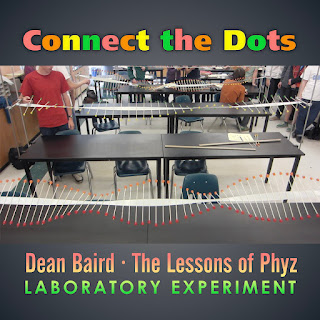
Connect the Dots [Lab]

In this activity, students build a simple wave machine and observe wave propagation, reflection, and the factors that determine wave speed. This activity takes a bit of unusual prep work, and some parameters cannot be quantitatively controlled. But it's the only lab that students routinely captured photos and videos to post to their social media accounts.

I posted a "how-to" construction video to YouTube: Connecting the Dots.

Wednesday, March 23, 2022

A Bundle of Phyz: ENERGY

This busy bundle opens with springboards introducing gravitational potential energy and kinetic energy.
The Mechanical Universe's episode on "Potential Energy" includes a nice historical perspective via Roger Boscovich. Ranking tasks for potential energy and kinetic energy close out the mechanical energy introductions.

Next up is an exercise in tracking energy transformations. In the Before Times, students drew their own sketches. In remote teaching/distance learning (RT;DL) that became impractical. In class, I followed this lesson with a showing of the classic Honda Cog ad. Two minutes of energy transformations, with some nice unstable equilibrium configurations, to boot. No CGI, and it only required a bit more than 600 attempts to nail it. OK Go's "This Too Shall Pass" video presents even more shining examples.

Physics in the Fountain of Fizz [Virtual Demonstration]

The Diet Coke Mentos geyser seems to have erupted onto the popular culture scene around 2006. Many analyses of the geysers focused on the "chemistry" of the eruptions: the interaction between the candy's shell and the soda.

To be a bit different, I created this activity to focus on the physics of the eruptions. When remote teaching/distance learning (RT;DL) came along, I was determined to keep this demo alive.

Wednesday, March 16, 2022

A Bundle of Phyz: MOMENTUM

The bundle opens with the springboard (guided classroom discussion with presentation) that introduces momentum.

Next we have the "Take a Flying Leap" springboard, an exploration of impulse that ends with me jumping off the historic Victoria Falls Bridge between Zambia and Zimbabwe.

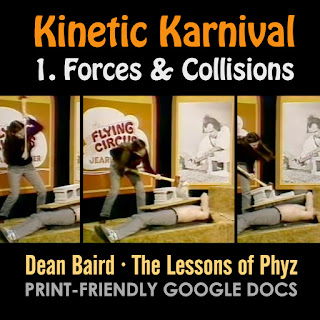
The Kinetic Karnival of Jearl Walker then takes us through stories and demonstrations of "Forces & Collisions". Jearl chops through concrete bricks with his bare hands and survives a cinder block being smashed on his chest while sandwiched between two beds of nails.

Kinetic Karnival - Episode 1: Forces & Collisions

Before Jearl Walker became the current author of the famed Fundamentals of
Physics by Halliday, Resnick, and Walker, he was a pioneering popularizer of physics, even appearing on The Tonight Show with Johnny Carson. He authored "The Amateur Scientist" for Scientific American and the classic, The Flying Circus of Physics — With Answers. [The Flying Circus of Physics (without answers) was published and can probably be found by skilled book hunters.

I was a fan of Walker and his work when I walked into my classroom for the first time. So when I saw that The Kinetic Karnival of Jearl Walker, filmed, produced, and broadcast just a few years prior was available for purchase, I directed my school budget to do so.

Tuesday, March 15, 2022

Things That Go "Bump" [Virtual Demonstration]

Is there more force when objects collide and stick to one another or when objects collide and bounce off each other?

This classic demonstration shows an important difference between elastic and inelastic collisions using "happy" and "sad" balls.

During remote teaching/distance learning (RT;DL), I produced this version of the demonstration. The instructional presentation link is included in the answer key; it's best if the instructor guides students through this. For Zoom presentations, Instant Reaction polls are included.
Includes
Student document (print-friendly Google Docs file on Google Drive)
Instructional presentation with observation videoclips (link embedded in answer key)
Answer key

Take a Flying Leap [Springboard]

Once momentum is introduced in my class, I waste little time moving onto the topic of impulse. Eggs are tossed; grass omelettes are made. Slow-motion videoclips are captured and reviewed in class.

We eventually get to this guided classroom discussion, where we learn more about how impact time affects impact force. Examples are cited, and videoclips are featured. I took a flying leap from the historic Victoria Falls Bridge between Zambia and Zimbabwe in the name of science. A Victoria Falls bungee mishap is also shown. As is a GoldenEye 007 bungee stunt, and a skydiver who chooses not to use a parachute.

Sunday, March 13, 2022

A Bundle of Phyz: GRAVITY

The bundle opens with
The Mechanical Universe's "Kepler's Three Laws" which set the stage for Newton's work on universal gravitation.

"Be Newton for a Day" retraces Newton's fabled derivation of F=GMm/R^2 from geometry, Kepler's Rule, and a few insights of his own.

"The Apple and the Moon" is The Mechanical Universe's telling of how Newton derived and mathematically proved his inverse square law.

"The Laws of Attraction" is a PhET-fueled investigation deeper into the mathematical relationships in universal gravitation.

Be Newton for a Day [Springboard]

I don't remember when I learned that Isaac Newton often wrote is findings as a series of "queries"; questions whose answers are always "yes".

But when I wanted to work through the derivation of Newton's universal gravitation equation, I thought it would be amusing to sequence it as a series of queries. As I often did with my lab reports in The University of Michigan's Physics 403 optics lab (c. 1985), where a young Dr. David Gidley indulged my creativity, I designed the document to look more of the era of Newton. (My reports incorporated such eighteenth-century anachronisms as "opticks" and "reflexions". Dr. Gidley was a good sport.)


Includes
Student document (print-friendly Google Docs file on Google Drive)
Instructional presentation (link embedded in the answer key)
Answer key

Thursday, March 10, 2022

A Bundle of Phyz: FORCES

The bundle opens with a PhET-fueled simulation lab activity that I used as a precursor to an in-class, hands-on experiment involving carts and motion tracking (not included here).

Next we have an in-class (in-Zoom?) direct instruction activity fleshing out Newton's Second Law via a series of fanciful shopping cart races.

Paul Hewitt offers instruction in Conceptual Physics Alive's "Newton's Second Law".

The bundle is a bit weak in Third Law curriculum. That topic is best taught via hands-on activities. But we do have Hewitt's "Newton's Third Law" and The Mechanical Universe's "Newton's Laws".

Newton's Second Law [Springboard]

The instructor leads students through this worksheet via classroom discussion and the included presentation.

Newton's Second Law is the topic. I conduct this lesson in my own class after lab activities that establish Newton's second law: a = F/m.

After some exposition, the lesson proceeds with the analysis of a sequence of grocery cart races. The lesson ends with a few calculations using F = ma.


Includes
Student document (print-friendly Google Docs file on Google Drive)
Presentation (link embedded in answer key)
Answer Key