Showing posts with label Physics: Cinema Classics. Show all posts

Tuesday, May 24, 2022

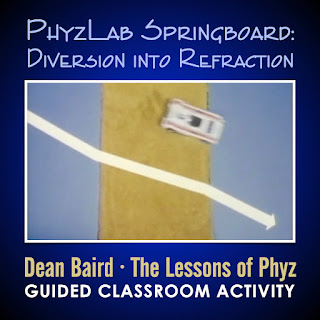
Diversion into Refraction [Lab Springboard]

This activity acts as an introduction to refraction. Prior knowledge: sound travels faster in solids (like steel) than it does in air. So what about light? Does it travel faster in transparent solids (like glass) than it does in air? Isaac Newton thought so.

We use the classic "car on carpet" model to explore the question. A toy car is rolled at an oblique angle down a ramp. There are hard surfaces, and there are carpeted surfaces. The direction of the car's path is affected by moving through the different surfaces.

Wednesday, March 23, 2022

A Bundle of Phyz: ENERGY

This busy bundle opens with springboards introducing gravitational potential energy and kinetic energy.
The Mechanical Universe's episode on "Potential Energy" includes a nice historical perspective via Roger Boscovich. Ranking tasks for potential energy and kinetic energy close out the mechanical energy introductions.

Next up is an exercise in tracking energy transformations. In the Before Times, students drew their own sketches. In remote teaching/distance learning (RT;DL) that became impractical. In class, I followed this lesson with a showing of the classic Honda Cog ad. Two minutes of energy transformations, with some nice unstable equilibrium configurations, to boot. No CGI, and it only required a bit more than 600 attempts to nail it. OK Go's "This Too Shall Pass" video presents even more shining examples.

Monday, March 7, 2022

A Bundle of Phyz: INERTIA

[Update 3/10/22: Added Newton's First Law Springboard.]

This bundle opens with an activity that was conducted as a lab but was repurposed as a demonstration during remote teaching/distance learning (RT;DL). It's a station exploration of "Inertia in Action".

Next up is "Clever Dumbbell," a classic inertia demonstration that challenges intuition.

Another classic follows with "Cannonball," where a cannonball is dropped from the mast of a moving ship.

Sunday, March 6, 2022

Cannonball [Virtual Demonstration]

This is the classic physics thought experiment attributed to Galileo: What happens to a cannonball dropped from the mast of a moving ship?

Except here, we animate it. And in 1968, a talented crew reenacted and filmed it for the Project Physics curriculum. The footage was included in Ztek's Physics: Cinema Classics.

The lesson here invites students to argue for various outcomes and then invest in one. After seeing the actual outcome, students are asked to describe how the demonstration could be modified to produce other outcomes.

Friday, March 4, 2022

Moving Sources [Virtual Demonstration]

Video clips from classic PSSC and other films are used here to show what happens when a wave source is moving while it makes waves. [Sourced from
Ztek's Physics: Cinema Classics.]

It is recommended that you work through the included (linked) presentation with the answer key in hand (practice) before showing this in class. The activity should be guided by the instructor.

There are some nice multimedia clips at the end and a Big Bang bonus after the end credit slide, where Sheldon attends a Halloween party dressed as the Doppler effect.


Given the variety of video assets used in the linked presentation, this is another Fair Use freebie.

I added this one to the Bundle of Phyz: WAVES AND SOUND.

Bell Jar [Virtual Demonstration]

In space, no one can hear you scream.

We put the famous tagline from Alien to the test in this demonstration. It's the classic bell jar in which a bell in a bell jar is subjected to a high vacuum as we listen for the sound.

The Encyclopedia Britannica Education Corporation's (EBEC) "Learning About Sound" 2nd Edition, 1974 filming of this demonstration was masterfully executed. 

  • Smoke is added to the bell jar prior to evacuation so that the air can be seen. And that smoke is thick! When it's gone, the air is essentially gone.
Wednesday, March 2, 2022

The Great Bullet Race [Virtual Demonstration]

A demonstration of the independence of vertical and horizontal motion in projectiles.

As the pandemic rolled from the spring of 2020, through the summer, and on into the fall, I started working on ways to move classic demos and labs into the realm of remote teaching/distance learning (RT;DL as I cleverly recoined the popular TL;DR abbreviation).

The Great Bullet Race was an early effort. I wrote about it on The Blog of Phyz.

I used a clip from an old Physical Sciences Study Committee (PSSC) film, "Free Fall and Projectile Motion" (1960), as restored by Ztek in Physics: Cinema Classics (P:CC).