Showing posts with label Pearson. Show all posts

Thursday, October 1, 2015

Simulating the Atom and Nucleus [undergoing transformations]

The PhET program at the University of Colorado/Boulder has been making quality simulations since the 1990s. I don't recall the exact details of when I started crafting activities around them. But I know I chose to work PhET-based activities into my Conceptual Science lab manuals because I could count on them being universally accessible, free of charge.

When PhET ported its legacy Flash and Java sims into HTML5, some characteristics of the sims changed. Some of the changes broke some of the activities I had written for the original simulations.  

Here are the activities I've written for sims involving the atom and the nucleus.

Shine a Light [Photoelectric Effect] at PhET
Using PhET's Photoelectric Effect, investigate the nature of the photoelectric effect and determine the work function of an unknown metal. This activity is included in the Conceptual Physics 12th edition lab manual at Pearson.

Radioactive Speed Dating [Radiometric Dating] at PhET
Using PhET's Radioactive Dating Game sim, correctly estimate the age of the various virtual objects (skulls, rocks, etc.) using the principles of radiometric dating

Tuesday, September 1, 2015

Simulating Light and Optics [undergoing transformations]

The PhET program at the University of Colorado/Boulder has been making quality simulations since the 1990s. I don't recall the exact details of when I started crafting activities around them. But I know I chose to work PhET-based activities into my Conceptual Science lab manuals because I could count on them being universally accessible, free of charge.

When PhET ported its legacy Flash and Java sims into HTML5, some characteristics of the sims changed. Some of the changes broke some of the activities I had written for the original simulations.

Here are the activities I've written for sims involving light and optics.

Pixel Peeping [Color Mixing] at PhET
Using PhET's Color Mixing sim, use a magnifier to examine the pixels of a computer display and see how the display’s colors are created. This activity is included in the Conceptual Physics 12th edition lab manual at Pearson.

Fun With Colors [Color Mixing] copy from my Google Drive
I used this activity as an extension of Pixel Peeping. No magnifier required.

Fringe of Optics [Interference] at PhET
Using PhET's Wave Interference sim, construct the mathematical relationship describing interference patterns. 

Saturday, August 1, 2015

Simulating Waves and Sound [undergoing transformations]

The PhET program at the University of Colorado/Boulder has been making quality simulations since the 1990s. I don't recall the exact details of when I started crafting activities around them. But I know I chose to work PhET-based activities into my Conceptual Science lab manuals because I could count on them being universally accessible, free of charge.

When PhET ported its legacy Flash and Java sims into HTML5, some characteristics of the sims changed. Some of the changes broke some of the activities I had written for the original simulations.  

Once upon another time, Pasco Scientific produced and developed an application called DataStudio. It's primary purpose was to monitor and process data from Pasco's sensors. But it also had a sound creation and monitoring capability called Waveport. Pasco reimagined its data processing software when it developed Capstone and Spark. Data monitoring was improved. But sound capabilities were left behind. I was a big fan of Waveport and have yet to find a suitable replacement.

Here are the activities I've written for sims involving waves and sound. 

Water Waves in an Electric Sink [Mechanical Waves] on Teachers Pay Teachers
Originally developed using PhET's original Wave Interference sim, this now can now also use PhET's Waves Intro sim. I use this as a classroom activity. At certain points during the period, I will interrupt the students with discussions of what they've learned so far. This activity is included in the Conceptual Physics 12th edition lab manual at Pearson.

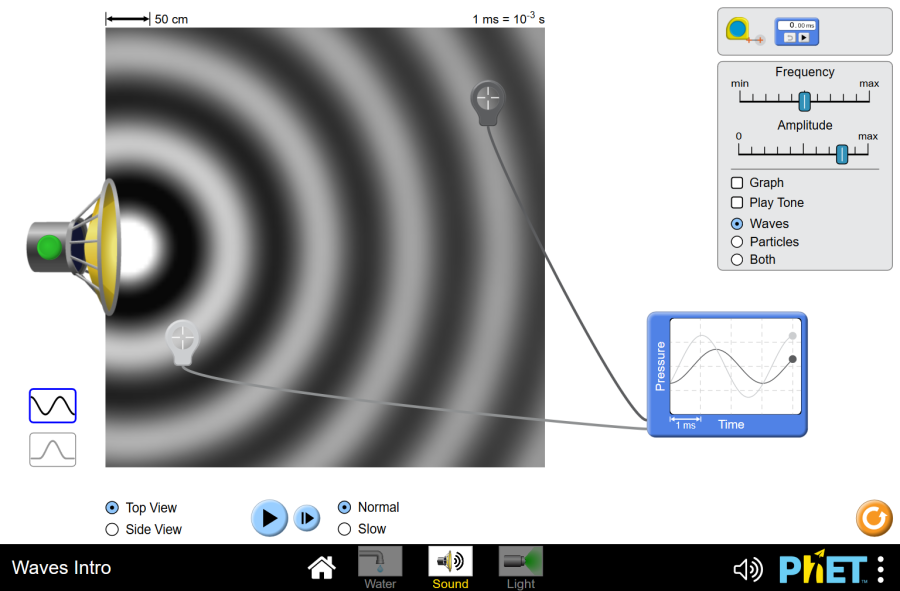
Using PhET's Waves Intro sim, investigate the differences between high and low sounds and loud and quiet sounds in terms of wave properties.

Wah-Wahs and Touch-Tones [Beats and Superposition] copy from my Google Drive
This activity was built around Pasco's DataStudio Waveport interface. That software has been discontinued. I was able to continue using it in Mac OS X 10.14 Mojave, but 10.15 Catalina won't run it. So macOS 11 Big Sur and macOS 12 Monterey are no go, too. If you know of something that matches its functionality and still works, let me know in the comments. This activity is included in the Conceptual Physics 12th edition lab manual at Pearson.

Wednesday, July 1, 2015

Simulating Electricity and Magnetism [undergoing transformation]

The PhET program at the University of Colorado/Boulder has been making quality simulations since the 1990s. I don't recall the exact details of when I started crafting activities around them. But I know I chose to work PhET-based activities into my Conceptual Science lab manuals because I could count on them being universally accessible, free of charge.

When PhET ported its legacy Flash and Java sims into HTML5, some characteristics of the sims changed. Some of the changes broke some of the activities I had written for the original simulations. 

Original John Travoltage was more fun than HTML5 John Travoltage, in my experience. The audio seemed to be a sample from John Travolta, himself. Over-charging John resulted in a quirky form of corona discharge. Most importantly, it was possible to sustain a maximum-length discharge indefinitely. Good times. Oh, well.

Here are the activities I've written for sims involving electricity and magnetism.

Greased Lightning [Charging and Discharging] at PhET
Using PhET's John Travolage sim, determine the likelihood of getting a “carpet shock” (based on controllable variables), and to avoid or produce such shocks under a series of challenging conditions. This activity is included in the Conceptual Physics 12th edition lab manual at Pearson.

Quest for the Coulomb Cup [Electric Fields] at PhET
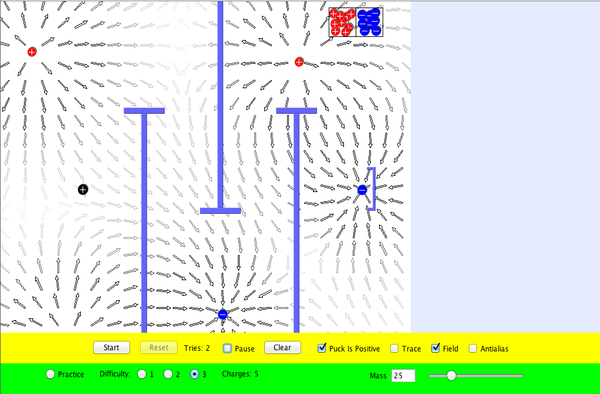
Using PhET's Electric Field Hockey sim, use a simulation to gain a sense of the vector nature of the electric field and the consequence of the inverse square law that governs electrostatic force by completing a series of game-like challenges. This activity is included in the Conceptual Physics 12th edition lab manual at Pearson.

Lectric Plates [Uniform Electric Fields] at PhET
Using PhET's Capacitor Lab sim, vary the variables that affect the electric field between charged paltes and see what happens.

Two-Plate Special [Capacitance] at PhET
Using PhET's Capacitor Lab sim, learn the characteristics and relationships that govern parallel-plate capacitors.

Batteries & Bulbs [Circuits] at Teachers Pay Teachers
Using PhET's Circuit Construction Kit *DC) sim, explore various arrangements for delivering energy from the battery to the bulbs, and how some arrangements compare with the others. [This was written during the pandemic to emulate an existing in-person lab activity.]
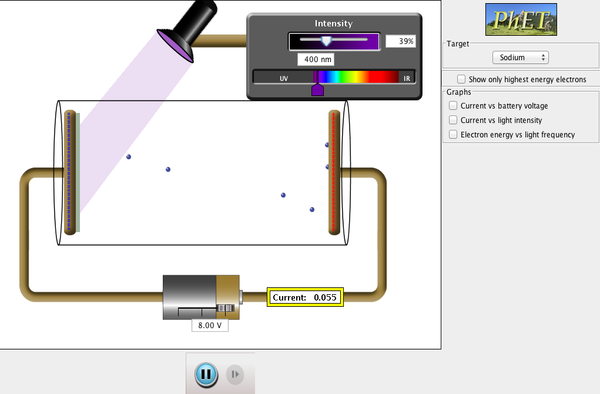
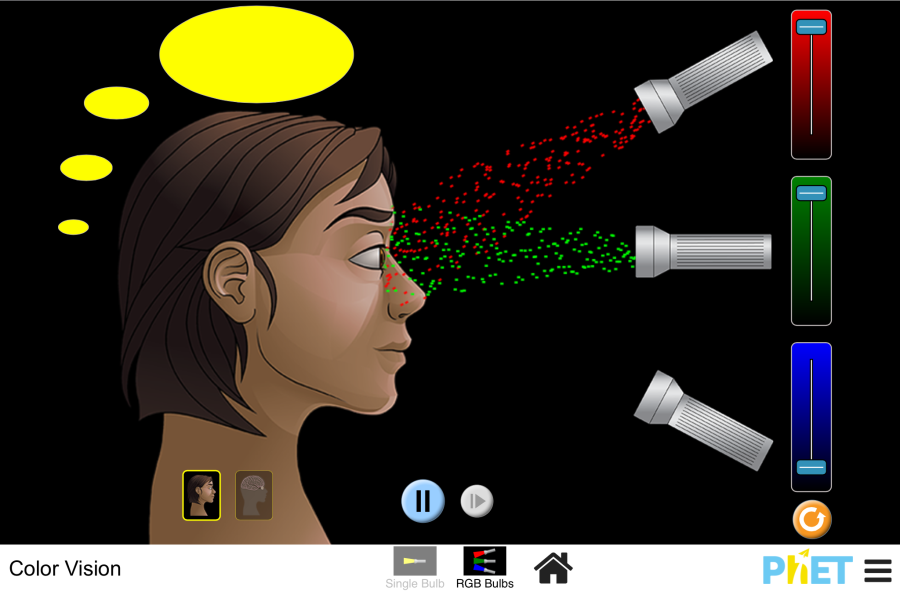
Faraday's Electromagnetic Lab [Electromagnetism] at PhET
Using PhET's Faraday's Electromagnetic Lab sim, manipulate simulated magnets, compasses, and coils to see how magnetic fields interact with electric currents. This activity is included in the Conceptual Physics 12th edition lab manual at Pearson.

Monday, June 1, 2015

Simulating Fluids and Heat [undergoing transformations]

The PhET program at the University of Colorado/Boulder has been making quality simulations since the 1990s. I don't recall the exact details of when I started crafting activities around them. But I know I chose to work PhET-based activities into my Conceptual Science lab manuals because I could count on them being universally accessible, free of charge.

When PhET ported its legacy Flash and Java sims into HTML5, some characteristics of the sims changed. Some of the changes broke some of the activities I had written for the original simulations.  

Here are the activities I've written for sims involving fluids and heat.

Pool Cubes: Density [Density] at PhET
This was developed with PhET's original Density sim. The Density sim has since been updated to HTML5. I have not yet tested the activity instructions on the updated sim. In any case... In this activity, students rank items by mass, size, density, and to determine a density-based rule for floatation. This activity is included in the Conceptual Physics 12th edition lab manual at Pearson.

Pool Cubes: Buoyancy [Buoyancy] at PhET [Unavailable pending simulation update.]
This was developed with PhET's original Buoyancy sim. The Buoyancy sim is being updated to HTML5. I have not yet tested the activity instructions on the updated sim. In any case... Investigate the nature of the buoyant force and to see the role it plays in determining whether or not an object floats. The ability to use a variety of objects in the liquid and to vary the density of the liquid makes a number of scenarios possible. This activity is included in the Conceptual Physics 12th edition lab manual at Pearson.

Bouncing Off the Walls [Kinetic Theory] at PhET
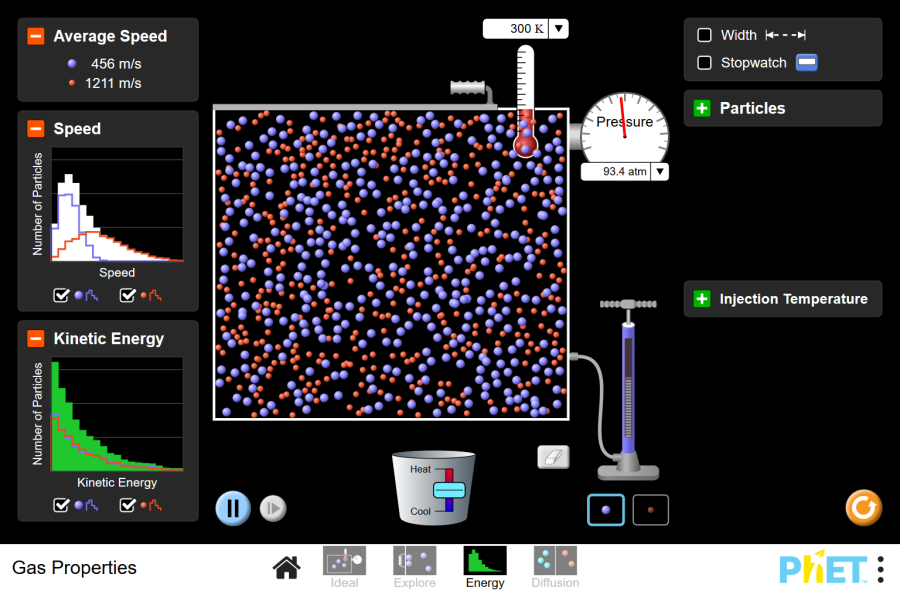
This was developed with PhET's original Gas Properties simulation. When the sim was updated to HTML5, the since model changed. Adiabatic heating still happens under compression, but adiabatic cooling no longer occurs under expansion. Using PhET's Gas Properties sim, control and observe the behavior of gas particles (atoms or molecules) as modeled in a simulation to investigate properties of gas such as temperature and pressure. 

Wednesday, April 1, 2015

Simulating Motion and Forces [undergoing transformations]


The PhET program at the University of Colorado/Boulder has been making quality simulations since the 1990s. I don't recall the exact details of when I started crafting activities around them. But I know I chose to work PhET-based activities into my Conceptual Science lab manuals because I could count on them being universally accessible, free of charge.

When PhET ported its legacy Flash and Java sims into HTML5, some characteristics of the sims changed. Some of the changes broke some of the activities I had written for the original simulations. 

In the case of Projectile Motion, my activity requirements forced me to use a different online simulation: Galileo and Einstein by University of Virginia's Physics Department.

In the case of My Solar System PhET is in the process of upgrading the sim to HTML5 as of this writing. So this alternative was found. (Hat tip: Dan Burns.)

Here are the activities I've written for sims involving motion and forces.

Motivating the Moving Man [Graphical Kinematics] at Teachers Pay Teachers
Using PhET's Moving Man sim (CheerpJ Java as of this writing), investigate motion graphs by manipulating a simulated on-screen “moving man.” The simulation produces graphs representing the motion of the man. This activity is included in the Conceptual Physics 12th edition lab manual at Pearson.

Dodge Nitro Jump [Free Fall Algebraic Kinematics] at Teachers Pay Teachers
This currently uses Galileo and Einstein's Projectile Motion Applet. As of this writing, PhET's HTML5 Projectile Motion simulation limits initial speeds to 30 m/s, which is too slow for this activity.

Tavurvur Erupts [Projectile Motion] at Teachers Pay Teachers
This currently uses Galileo and Einstein's Projectile Motion Applet. As of this writing, PhET's HTML5 Projectile Motion simulation limits initial speeds to 30 m/s, which is too slow for this activity.

Pushing Things Around [Newton's Second Law] at Teachers Pay Teacher
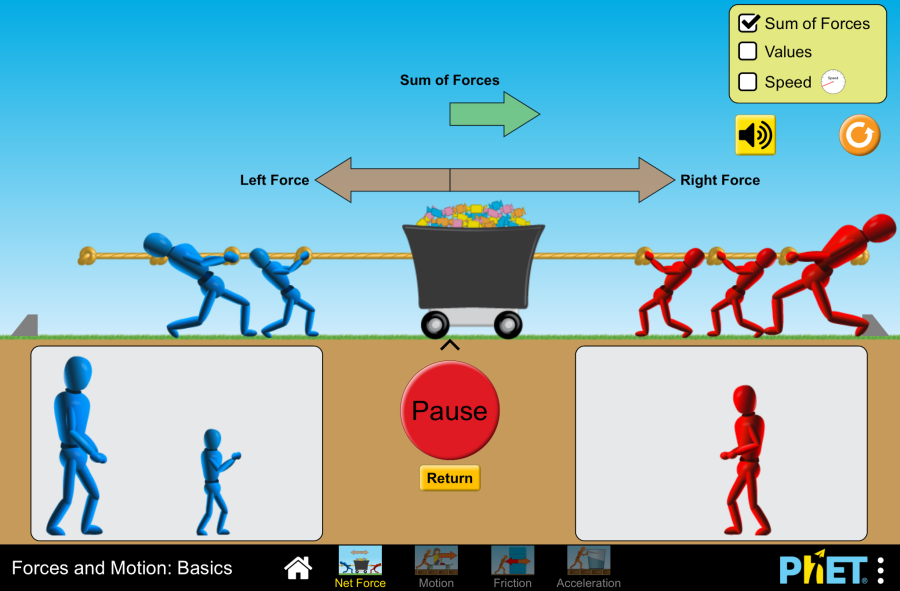
Using PhET's Force and Motion: Basics sim, investigate the relationship between force and motion using the “Forces and Motion: Basics” PhET simulation. This activity is included in the Conceptual Physics 12th edition lab manual at Pearson.

The Laws of Attraction [Universal Gravitation] at Teachers Pay Teachers
Using PhET's Gravity Lab sim, investigate the quantitative nature of gravitational attraction. This activity is included in the Conceptual Physics 12th edition lab manual at Pearson.

Worlds of Wonder [Orbital Mechanics] at Teachers Pay Teachers
PhET's My Solar System sim is not operational as of this writing. Using this Open Stax My Solar System alternative, use a simulation to study the orbital mechanics of a simplified solar system. A version of this activity is included in the Conceptual Physics 12th edition lab manual at Pearson.

Friday, January 1, 2010

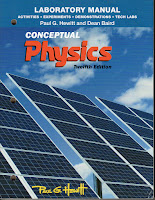
Conceptual Physics Lab Manual

After authoring (and/or wrangling) lab manuals for Conceptual Physical Science, Conceptual Integrated Science, Conceptual Physical Science Explorations, and Conceptual Integrated Science Explorations, I was invited to write a lab manual for Conceptual Physics, the grand daddy of the Conceptual Science family. 

I had no shortage of material. I had been writing labs for my own physics students since the 1980s. My constellation of influences included Paul Robinson, PRISMS, Dewey Dykstra, Jim Minstrell, Fred Goldberg, Lillian McDermott, Arnold Aarons, and many others. But I had my own vision of what made for a good lab activity, too.

Over the years, I concocted plenty of duds. But also many keepers. The keepers I polished each year based on classroom experience with real students.

Porting my own classroom labs over to lab manual labs was non-trivial. I authored my work in art/design software: Silicon Beach Software SuperPaint, then Deneba Canvas, then Apple Keynote. I prioritized art over text. But Pearson needed "camera ready copy" in Microsoft Word. Word had quirks to be wrestled with, and it was not a platform designed for creating exacting art. Personal touches and inside joke had to be stripped. But the core purpose and process was to be retained.

The lab manual for the 12th edition of Conceptual Physics was the last one Pearson asked for. It was the best one I wrote for the Conceptual Science team in terms of activity quality and textbook alignment. The 13th edition of Conceptual Physics was subsequently published without a corresponding lab manual.


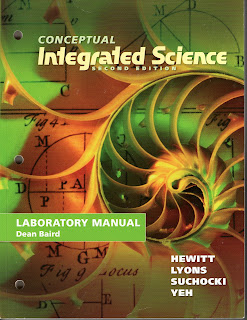
Conceptual Integrated Science Explorations

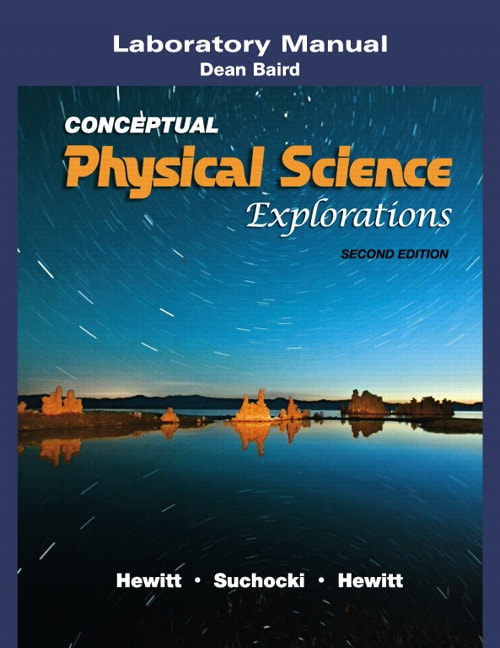
Following the success of 2007's Conceptual Integrated Science for the college textbook market, Conceptual Integrated Science Explorations was produced for the school (7-12) market. It was published in 2010.

This title mirrored Conceptual Physical Science Explorations for the school market. The content once again added biology to physics, chemistry, and earth science.

Most of my work was to align the lab manual to the textbook in terms of the sequencing.

In 2017, Pearson sold its K-12 division but maintains its Higher Ed division.


Monday, January 1, 2007

Conceptual Integrated Science


Suzanne Lyons had a vision of expanding Conceptual Physical Science to include biology: Conceptual Integrated Science.

On Hewitt's Conceptual Science team, I was the lab manual author, so I was asked to handle the lab manual for this title.

But I was a mere high school physics teacher with a full-time job teaching physics. I had more than enough physics lab ideas, but I was already using John Suchocki's chemistry labs and Leslie Abrams' earth science labs in the Conceptual Physical Science titles. Biology labs? Not a chance. I was in over my head.

Suzanne contributed great earth science labs, and we outsourced biology labs from Anne Coleman. My contribution was formatting them and giving them the kind of whimsical titles so they matched the style of the manual.

I probably should have been credited as the lab manual wrangler. But in the wild world of publishing, that made me author of record.

The second edition lab manual ran into production difficulties and was a bit delayed, but it eventually saw the light of day. Of all the lab manuals I produced, this is the one best aligned to its corresponding textbook. I'm proud of that. It also seems to have lost its place in the Pearson catalogue. The 3rd edition of the Conceptual Integrated Science textbook has since been published without a lab manual.


Thursday, January 1, 2004

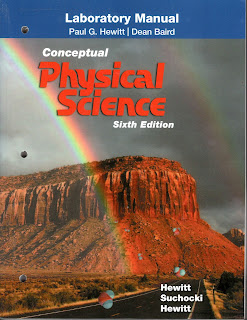
Conceptual Physical Science

As soon as Conceptual Physical Science Explorations was published, it was time to get to work on the 3rd edition of the college Conceptual Physical Science.

I could now use the CPSE lab manual as a foundation and bring more of my own labs into the project. The insanity of the tight CPSE timeline was no more. I was getting better at MS Word: learning how to work around its quirks and learning how to create diagrams with its art tools. The 3rd edition (my 1st edition on the team) was published in 2004.

The Conceptual Physical Science textbook did very well in the marketplace. Fourth and 5th editions followed in 2008 and 2012.

Hewitt became a regular at NSTA conferences in this era, and I joined him every chance I got. Pearson would typically schedule a session for him to promote the school (Explorations) Conceptual Science textbooks. Hewitt had me describe the nature of the lab manual within his session. I brought photos, and I brought demonstrations. The conferences were always a good chance to hang out with the Hewitts and catch up with friends at Arbor Scientific, Pasco, and PhET. I actually worked the PhET booth for several hours when NSTA came to San Francisco.

Wednesday, January 1, 2003

Conceptual Physical Science Explorations

How I Met Paul Hewitt
I attended my first Northern California and Nevada Section of the American Association of Physics Teachers meeting in the autumn of 1986 at American River College in Sacramento. Among the instructors doing Show & Tell that morning was Conceptual Physics author, Paul Hewitt.

There aren't many celebrities in the world of physics teachers, but Paul Hewitt was one. His Conceptual Physics textbook had been growing in popularity at colleges since 1971, and the then-new Conceptual Physics: A High School Program was in the process of shaking up the high school physics textbook market.

But there was Hewitt, just another person in the queue to present a demonstration to the NorCal family of physics instructors. I did my best to play it cool.

In 1989, the AAPT's Summer Meeting was in San Luis Obispo. This was my first national meeting. One day at lunch, I found myself across the table from Hewitt and we chatted it up, but I gave him no reason to remember me.