Showing posts with label Book of Phyz. Show all posts

Saturday, December 14, 2024

You're Probably Wrong About Rainbows

Veritasium's Derek Muller did a deep dive into rainbows, and brought his YouTube content creator skills to bear in articulating an explanation. 

I thought I dove pretty deep in my Understanding Rainbows classroom lesson. Derek dialed it up to 11 in You're Probably Wrong About Rainbows.

Naturally, I had questions.

You probably don’t understand how a rainbow really works. In this video, Veritasium’s Derek Muller dives deep into the optics of rainbows. Caustics and Brewster’s angle deep. The video is divided into chapters; see the product listing for complete details.

Monday, May 30, 2022

Mirages [Lab Springboard]

This activity mixes a lab activity with a springboard lesson to explore the optics and perception of mirages and looming (inferior and superior images).

The recommended equipment is Arbor Scientific's Laser Viewing Tank.

To make this lesson work, you begin by setting up the "skinny fish tank" with water and corn syrup or sugar. Then you go through the "paper and pencil" lesson about the optics of mirages, and why they are perceived as bodies of water. Then it's time to hit the tank with the lasers to see how the index gradient causes the beam to curve. By then, the connection between curving light rays and mirages is understood.

Wednesday, May 25, 2022

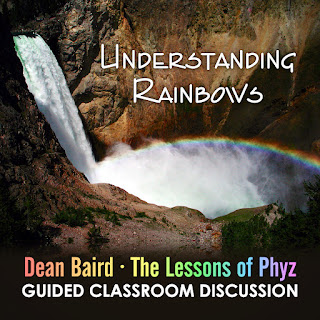
Understanding Rainbows [Springboard]

Second only to "Why the Sky is Blue" in ambition, I would rank this as one of the best lessons I have authored. 

With rainbows, the physics is relatively simple (once you've covered refraction and dispersion) and the geometry is simple. Putting them together? Well, this is a four-page lesson. It takes a bit of time to work out the details.

The post-lesson "extras" in the presentation are amusing rewards. The "Double Rainbow" video has mostly faded from cultural awareness among students, so it's new to them! Is the dramatic interpretation over the top? Yes it is.
Includes
Student document (print-friendly Google Docs file on Google Drive)
Instructional presentation (link embedded in answer key)
Answer key

Diversion into Dispersion [Lab Springboard]

This is an exploration of differential refraction: white light is dispersed into a spectrum by a prism. The activity explores the physics behind dispersion before giving a name to the phenomenon. 

Pink Floyd's classic album cover for Dark Side of the Moon is evaluated: what's right and what's wrong with the illustration? [I painted a 10' x 30' mural of Storm Thorgerson's image outside my physics classroom.]

Student document (print-friendly Google Docs file on Google Drive)
Instructional presentation (link embedded in answer key)
Answer key

Tuesday, May 24, 2022

Index of Refraction [Springboard]

Examples of vacuum, glass, and gallium phosphide are used as we define and apply the index of refraction. Ratios of speeds, wavelengths, and sines of angles are involved. Interesting graphical tangents are visited, and a numerical sample problem is included.


Includes
Student document (print-friendly Google Docs file on Google Drive)
Instructional presentation (link embedded in answer key)
Answer key

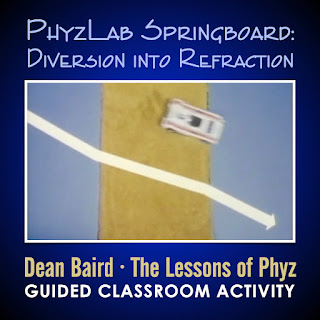
Diversion into Refraction [Lab Springboard]

This activity acts as an introduction to refraction. Prior knowledge: sound travels faster in solids (like steel) than it does in air. So what about light? Does it travel faster in transparent solids (like glass) than it does in air? Isaac Newton thought so.

We use the classic "car on carpet" model to explore the question. A toy car is rolled at an oblique angle down a ramp. There are hard surfaces, and there are carpeted surfaces. The direction of the car's path is affected by moving through the different surfaces.

Wednesday, May 11, 2022

New Electromagnetism Lessons Added

Right hand rules in high school physics do not bring me great joy. I cringed when The Physics Teacher ran a photoessay from an instructor who photographed students contorting hands during an exam. (A cursory search for this article was unsuccessful. I hope it was expunged.) 

Nevertheless, 3-D geometry cannot be avoided when studying magnetic fields and forces. In the Ørsted's discovery lab, students develop a right hand rule relating to current and the magnetic field it produces. That was Right Hand Rule #1.

This activity relates current, external magnetic field, and magnetic force. Right Hand Rule #2.

Friday, April 29, 2022

Switch Wars [Design Lab]

Design Challenge:
Using only a battery, bulb, wires, and two single pole double throw switches, make a “three-way” switch. A three-way switch involves 2 two-position switches (like common light switches in houses). Either switch can be used to turn a light on or off. Such two-switch systems are often used for lights in stairways, long hallways, or for outdoor structures. Children (of varying ages) sometimes battle each other by stationing themselves at opposite switches; one tries to keep the light on while the other tries to keep it off.


Includes

Student document (print-friendly Google Docs file on Google Drive)

Answer key

Wednesday, April 27, 2022

Logic Gates [Lab + Job]

When I began the patient siege of outfitting my lab at Rio Americano High School (c. 1990), I leveled up on batteries (C- and D-cells), bulbs (various incandescent flashlight "mini bulbs"), connecting wires (alligator clip "jumpers") and switches (single throw, single and double pole ceramic and copper). 

My wish/shopping list came from Paul Robinson's Conceptual Physics: A High School Program by Paul Hewitt 1/e Lab Manual. I had tagged each lab I hoped to do, then assembled a spreadsheet list of the apparatus I would need.

And as was the case with my mechanics apparatus and materials, I began developing other labs for my students to conduct with those materials.

Tuesday, April 26, 2022

A Bundle of Phyz: MIRRORS AND LENSES

Much can be made of spherical mirrors and thin lenses in the geometric optics curriculum. Here are a few.

Is the image upright or inverted? Enlarged or reduced? In "Image Characterization," students are tasked with such determinations.

In "Mirror Experience," students gaze upon their reflections in a hand-held spherical mirror at various distances and characterize their own images.

"Ray Tracing 1 and 2" are exercises in drawing principal rays to construct images in spherical mirrors.

Sunday, April 17, 2022

A Bundle of Phyz: HARMONIC MOTION

The bundle opens with a PhET-fueled exploration of Hooke's law. "Spring to Another World" utilizes the
Masses and Springs simulation.

Then its on to a guided classroom discussion on elastic potential energy which works through a side-by-side compare and contrast with gravitational potential energy. Practice the equation developed in the springboard on a few toy gun number puzzles.

"Springs and Swings" provides a PhET-fueled introduction to simple harmonic motion, while also delving gently into Google Sheets and linearization. This one leverages Masses and Springs: Basics and Pendulum Lab.

Wednesday, April 13, 2022

A Bundle of Phyz: FLUIDS

When the College Board added fluids to the AP Physics B exam, I felt like I needed to create a new unit from whole cloth. This bundle includes most of what I subsequently produced over the years.

We begin with pressure and its idiosyncrasies, addressed in a springboard (guided classroom discussion) and a job (independent homework). Next we dive into PhET's Density pool in our first sink-or-float lab activity, "Pool Cubes 1 - Density."

Conceptual Physics Alive's telling of fluids begins with "Liquids I," in which he demonstrates principles using Pascal's vases, among other things.

Thursday, April 7, 2022

A Bundle of Phyz: ROTATION

The bundle opens with a guided classroom discussion on "A New Kind of Motion": rotation. It's fundamentally different from linear motion.

"A Question of Balance" is a PhET-fueled lab activity that sets and applies the conditions for balance using the Balancing Act sim. It's a nice precursor to an in-class, hands-on balanced torques lab.

"Torque" is a guided classroom discussion that builds toward an equation for torque by examining various factors one at a time.

A Bundle of Phyz: HEAT + THERMO

The bundle opens with a virtual demonstration of thermoscopes and a discussion of temperature scales. Next we have the classic ball and ring thermal expansion demonstration guide, followed by a demonstration to see the difference between hot and cold in a couple of ways.

The Mechanical Universe's "Temperature and the Gas Laws" is up next, followed by Conceptual Physics Alive's "Heat, Temperature, and Expansion".

Saturday, March 26, 2022

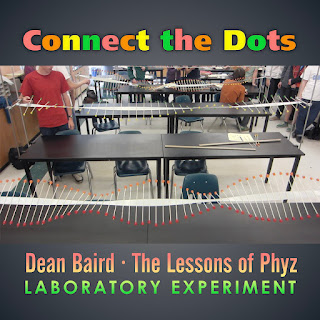
Connect the Dots [Lab]

In this activity, students build a simple wave machine and observe wave propagation, reflection, and the factors that determine wave speed. This activity takes a bit of unusual prep work, and some parameters cannot be quantitatively controlled. But it's the only lab that students routinely captured photos and videos to post to their social media accounts.

I posted a "how-to" construction video to YouTube: Connecting the Dots.

Wednesday, March 23, 2022

A Bundle of Phyz: ENERGY

This busy bundle opens with springboards introducing gravitational potential energy and kinetic energy.
The Mechanical Universe's episode on "Potential Energy" includes a nice historical perspective via Roger Boscovich. Ranking tasks for potential energy and kinetic energy close out the mechanical energy introductions.

Next up is an exercise in tracking energy transformations. In the Before Times, students drew their own sketches. In remote teaching/distance learning (RT;DL) that became impractical. In class, I followed this lesson with a showing of the classic Honda Cog ad. Two minutes of energy transformations, with some nice unstable equilibrium configurations, to boot. No CGI, and it only required a bit more than 600 attempts to nail it. OK Go's "This Too Shall Pass" video presents even more shining examples.

Wednesday, March 16, 2022

A Bundle of Phyz: MOMENTUM

The bundle opens with the springboard (guided classroom discussion with presentation) that introduces momentum.

Next we have the "Take a Flying Leap" springboard, an exploration of impulse that ends with me jumping off the historic Victoria Falls Bridge between Zambia and Zimbabwe.

The Kinetic Karnival of Jearl Walker then takes us through stories and demonstrations of "Forces & Collisions". Jearl chops through concrete bricks with his bare hands and survives a cinder block being smashed on his chest while sandwiched between two beds of nails.