Showing posts with label BBC. Show all posts

Friday, October 17, 2025

Human


It seems that each season, NOVA airs an in-depth series co-produced (created by?) the BBC. For Season 52, it's the five-part series, Human.

Around 300,000 years ago, Homo sapiens emerged in Africa—one of at least seven human species alive at the time. Now, we are the only remaining human line, and our impact on the planet is undeniable. In this stunningly cinematic five-part series, paleoanthropologist Ella Al-Shamahi traces the surprising story of human origins. Remarkable new fossil evidence, modern DNA sequencing, and other cutting-edge scientific tools are shedding new light on the lives and journeys of long-vanished human species, and how our encounters with them helped make us who we are today.

Tuesday, November 5, 2024

Solar System


PBS NOVA has once again teamed up with BBC for another space science miniseries. The Planets (2019) was followed by Universe Revealed (2021).

This year, it was deeper dive into the solar system. You might wonder what was left to document so soon (in space documentary years) after The Planets. What Solar System does is to open things up to include moons and dwarf planets. Suddenly to the topic candidates expand from fewer than a dozen to hundreds. We've been sending probes to explore these words for decades, and researchers have been able to identify and sort unexpected mysteries. 

Ice worlds composed of hot, black ice, volcanic worlds heated by tidal forces, dwarf planets that kiss more than they collide, comets, asteroids, and an unseen cloud of countless worlds. Solar System dives deep into some two dozen worlds in our own neighborhood, including Haumea, Ganymede, Miranda, Pan, Io, Enceladus, Iapetus, Phobos, Ceres, Triton, and Charon. Earth is included in the mix, correctly cast among the "Strange Worlds." Honestly, the more you know about Earth, the stranger it seems.

Thanks once again to my fourth-grade teacher, Mrs. Murphy, for encouraging me to deepen my fascination with the other worlds of the solar system years before the Vikings or the Voyagers.

Tuesday, October 10, 2023

Ancient Earth

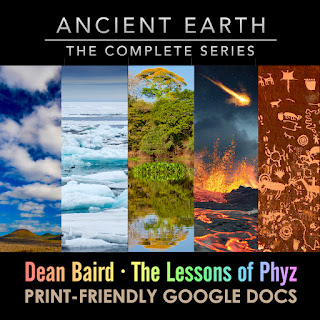
NOVA opened the the second half of its 50th season with a 5-part partnership with BBC called Ancient Earth. Previous such collaborations produced two spectacular series, The Planets and Universe Revealed. In any case, I have questions.

Ancient Earth BUNDLE on TPT 
Witness the dramatic history of Earth, from its birth to the emergence of humanity. Dive into the most dramatic events in Earth’s 4.5-billion-year history, from its birth to the emergence of humanity. How did a hellscape of molten lava transform into a lush, green, watery planet filled with life? With dazzlingly realistic animation based on the latest research, each of these five episodes brings to life long-lost worlds that ultimately led to the one we know today.
I have had the good fortune of seeing many excellent documentaries on Earth's atmosphere. This is the best one I've ever seen. [I used a photograph I took on Floreana Island in the Galápagos for the cover.]
Today, Earth is enveloped by a thin veil of gas, a narrow band of atmosphere that protects a world covered in lush green vegetation, deep blue oceans, and abundant life. But 4.5 billion years ago, Earth was a very different place: a hellscape of molten lava and barren rock, under relentless bombardment from meteors, and with no atmosphere whatsoever. So how did our familiar blue sky come to be? Breathtakingly realistic animations and a chorus of science experts reveal how the primordial inferno first gave rise to an orange-hued cauldron of toxic gasses that would be deadly to us today. Witness how the first drops of rain splashed down on the searing planet, setting the stage for the evolution of life. And discover how life itself helped create the air we all breathe today.

Cover photo: Baroness viewpoint on Floreana Island in the Galápagos, when I was there in 2008 during The Amazing Adventure 3 with James (The Amazing Randi).

This is the story of Snowball Earth, Rodinia, eukaryotic life, plate tectonics, silicate weathering, the fall and rise of atmospheric carbon dioxide, and the intertwined nature of biology and geology.
700 million years ago, Earth was a giant snowball cloaked in ice from pole to pole – a global deep freeze that held the planet in a stranglehold, threatening the survival of the earliest complex life. How did life manage to hold on in this forbidding world? Leading scientists investigate how this catastrophe may have become a catalyst for life to evolve in creative new ways as it bounced back from the brink – setting the stage for the astonishing complexity we see today.

Cover photo: The pack ice in the Arctic Ocean from the M/S Origo, summer 2018. 

This is the story of how plant life emerged from the ocean and populated the land. It was not a trivial matter. It required plate tectonics (which was apparently triggered by asteroid bombardment) for granite and carbon dioxide from volcanoes. And it required a symbiotic relationship with fungi to get from water onto land. "Prototaxites" was a new word for me.
For billions of years, life teemed in the oceans of planet Earth while the land was desolate and inhospitable. So how did life make the leap to land? Scientists explore how some of the earliest life emerged and invaded a barren, rocky landscape, eventually transforming it into a verdant, green world. Gripping visual effects reveal an alien landscape dominated by towering fungi before the arrival of plants. Witness how the first plants made landfall and partnered with fungi to create soil that would sustain them. And discover how, once life emerged on land, it fundamentally altered the very ground it grew on.

Cover photo: A riparian landscape taken while looking for jaguars in the Pantanal of Brazil's wild west, summer 2016. 

252 million years ago, the most devastating mass extinction of all time abruptly wiped out around 90% of all species on Earth. The culprits were the biggest volcanic eruptions the world has ever seen, emitting some 700 thousand cubic miles of magma and rock. Volcanic gasses permeated the atmosphere and acidified the oceans while toxic gasses destroyed the ozone layer, bathing the planet in destructive UV radiation. The event–now called “The Great Dying”–came close to wiping out all life on the planet. Follow scientists as they piece together geologic evidence from the deep past and clues from today’s ecosystems to discover how life made it through and evolved into the astonishing variety we see around us today.
The story of Earth can only be told because now, 4.5 billion years into its existence, a technological and self-aware animal species roams its surface, able to study the very planet that gave rise to it. But how exactly did Earth give rise to humans? Through stunningly realistic animation, witness the cataclysmic asteroid strike that wiped out the dinosaurs, the tumultuous changing climates that allowed early primates to spread across the planet, and the geologic events that created the conditions for the evolution of an animal that walks upright on two legs. Explore the power and paradox of humanity’s profound impact on our planet, and ponder the question of how we may shape its future.

Cover photo: Newspaper Rock in southeast Utah, as I saw it in April, 2004.  

Monday, August 7, 2023

The Story of Maths

There are some apparent contradictions with this one. It's British. It's the history of mathematics. And it's a little bit... spicy.

Adults are shown enjoying adult beverages. The use of mathematics to schedule conjugal visits between a Chinese emperor and the 121 women in his hareem is illustrated. A prolific author of math texts who never actually existed. A mathematician who upended the field before losing a duel before his 21st birthday. The story of a nightclub dancer protecting a prestigious mathematician from Nazi thugs is told. And more.

Amid these spices is the history of math from before the invention of the number zero to recent attempts to prove the Riemann hypothesis. Host Marcus du Sautoy travels the world to visit key historical locations and talk to notable contemporary mathematical giants.

This is the human story of math.

We do math. We love math. And math coursework is devoted to the ideas and mechanics of math. Rightfully so. Here are four hours that humanize math. It might be a worthy diversion to contextualize high school or college mathematics.

Thursday, April 6, 2023

Big Links Pages

Really just an excuse for me to post a favorite shot from Brooks Falls, Katmai, Alaska a few years ago. Arctic Lynx.

In any case, I always found some utility in big pages of links for video series. Links to videos (where possible) and question sets. So I made some for video series in various content areas. Here's what I've got.


A Personal Voyage [Carl Sagan 1980: 13 episodes]
A Spacetime Odyssey [Neil deGrasse Tyson 2014: 13 episodes]
Possible Worlds [Neil deGrasse Tyson 2020: 13 episodes]

Chemistry: A Volatile History [Jim Al-Khalili: 3 episodes]
Hunting the Elements ... Beyond the Elements [David Pogue]
Chemistry: Challenges and Solutions [13 episodes]
The World of Chemistry [Roald Hoffmann: 26 episodes]

How Earth Made Us | How the Earth Changed History [Iain Stewart: 5 episodes]
Earth Revealed: Introductory Geology [26 episodes]
The Habitable Planet: A Systems Approach to Environmental Science [13 episodes]

I'll keep these lynx links over in the bar on the right.

Saturday, April 1, 2023

The Big Page of Chemistry

When The Mechanical Universe series was posted to YouTube, I constructed an HTML page to index the episodes. Then I added the High School Adaptations and links to my TPT question sets. Now I've got a comprehensive The Mechanical Universe of Phyz web page that I found to be quite useful.

Now that I've created question sets for four series concerning Chemistry, I thought a Big Page of Chemistry might be in order.

Here's the link to the page: Chemistry

The series indexed (from fewest to most episodes) are

Chemistry: A Volatile History (with Jim Al-Khalili)
This BBC mini-series has been my best-selling chemistry series.

Hunting the Elements and Beyond the Elements (with David Pogue)
David Pogue is always kinetic and entertaining. Hunting is a two-hour special; Beyond was the decade-later mini-series sequel.

Chemistry: Challenges and Solutions (with a variety of host researchers)
Thirteen half-hour episodes cover many major topics in chemistry. And demonstrations are woven in nicely.

The World of Chemistry (with Roald Hoffmann)
Twenty-six half-hour episodes provide comprehensive coverage of chemistry topics. First aired in 1990, and the years have not been kind to it. The Mechanical Universe has aged much more gracefully. But the academic content is solid. Series demonstrator, Don Showalter, is always great fun.

Friday, March 10, 2023

Earth Science: The Bundles (with Environmental Science)

[Updated April 2023]

Once upon a time, I arranged six Earth science-based bundles filled with question sets for documentaries from NOVA, National Geographic, BBC, PBS, and The Universe. Since then, I've added many, many new titles. So I've updated those bundles with the new titles.


For maximum flexibility, get them all: A Megabundle of Science: EARTH · ENVIRONMENTAL · ASTRONOMY at TPT. It's updated so frequently, you'll need to click the link to see how many resources currently in the bundle. It's more than 55!

When teaching the topics listed below, take a look at these bundles. You might find something you'll like.

Wednesday, November 2, 2022

Order and Disorder: The Forces that Drive the Universe

I was late to the Jim Al-Khalili party, so I'm working through the back catalog, scrambling to catch up. So far, I've authored question sets for Atom, Chemistry: A Volatile History, Shock and Awe: The Story of Electricity, Gravity and Me, The Secrets of Quantum Physics, and Secrets of Size: Atoms to Supergalaxies.

I still have a few Al-Khalili gems to mine. For now, I'm adding this volume to my library.


In which Al-Khalili spins a thread that carries us from ancient Mesopotamia through

Thursday, September 8, 2022

Chemistry: we've got it

When I retired from classroom teaching in 2021, one project I set out upon was increasing the chemistry content on The Lessons of Phyz at Teachers Pay Teachers.

Physics teachers were fortunate enough to have David Goodstein's The Mechanical Universe (College and High School) at their disposal, to be used at their discretion. Better yet, they had Paul Hewitt's Conceptual Physics Alive!. All of these were in-depth, course-long series that covered nearly all the topics in introductory physics.

Surely there must be similarly comprehensive series in chemistry. 

Or not. Somehow the Goodsteins and Hewitts of chemistry either don't exist or have not had such good fortune in getting any comprehensive series green-lit. Talk to me, my colleagues in chemistry: what went wrong? If there's something missing from the list that follows, let me know.

What we do have is a couple of chemistry mini-series and one-offs that are delightful and work well in the chemistry curriculum. Here's what I've found so far.


Friday, June 10, 2022

Secrets of Size: Atoms to Supergalaxies

What would the universe look like if you were a billion times smaller or a billion times bigger? In this mind-bending series, Jim Al-Khalili will look at the universe across its vast range of size, ranging from the tiniest objects measuring just a few atoms, to vast structures consisting of hundreds of thousands of interconnected galaxies. Investigating these astonishing objects will reveal fundamental truths about our universe. At the end of each film, the audience will see the largest structures ever discovered in the universe and the smallest objects whose images scientists have managed to capture to date.

This series premiered on BBC Four in May, 2022. These question sets only have value if you can find and show the episodes. Until this miniseries makes it to, say, Amazon Prime via Spark or some such, you may need to be resourceful to access it. If you intend to assign it outside of class, make sure students will be able to access it.

Thursday, May 5, 2022

The Secrets of Quantum Physics

Professor of physics Jim Al-Khalili investigates the most accurate and yet perplexing scientific theory ever - quantum physics. The program's two episodes
stream on Amazon Prime. YouTube links have also been embedded in the text below and the titles in the student documents.

The history of and battle over quantum entanglement. Albert Einstein hated the idea that nature, at its most fundamental level, is governed by chance. Professor Jim Al-Khalili reveals how, in the 1930s, Einstein thought he'd found a fatal flaw in quantum physics because it implies that subatomic particles can communicate faster than light in defiance of the theory of relativity. Delightful bonus: "Tangled Up With You" by Eliza's Uncertainty, a perfect addition to your modern physics playlist.

Thursday, April 7, 2022

A Bundle of Phyz: HEAT + THERMO

The bundle opens with a virtual demonstration of thermoscopes and a discussion of temperature scales. Next we have the classic ball and ring thermal expansion demonstration guide, followed by a demonstration to see the difference between hot and cold in a couple of ways.

The Mechanical Universe's "Temperature and the Gas Laws" is up next, followed by Conceptual Physics Alive's "Heat, Temperature, and Expansion".

Sunday, March 13, 2022

A Bundle of Phyz: GRAVITY

The bundle opens with
The Mechanical Universe's "Kepler's Three Laws" which set the stage for Newton's work on universal gravitation.

"Be Newton for a Day" retraces Newton's fabled derivation of F=GMm/R^2 from geometry, Kepler's Rule, and a few insights of his own.

"The Apple and the Moon" is The Mechanical Universe's telling of how Newton derived and mathematically proved his inverse square law.

"The Laws of Attraction" is a PhET-fueled investigation deeper into the mathematical relationships in universal gravitation.

Tuesday, March 1, 2022

A Bundle of Phyz: NUCLEAR PHYSICS

Segment 4 of Physics of the Universe (the NGSS Three-Course Model physics course) is all about nuclear physics. There are only six segments for the whole course, and one of them is nuclear. I don't know about you, but I know I wasn't going hard at nuclear physics in my regular physics course prior to Physics of the Universe.

The bundle opens with a question set for Conceptual Physics Alive's "Radioactivity," followed by a PhET-fueled fun activity, "Radioactive Speed Dating" for some quick radiometric dating practice. 

Tuesday, February 22, 2022

A Bundle of Phyz: WAVES AND SOUND

Waves: it's difficult to communicate without them. I consider them to be fundamental to the study of physics. 

This collection opens with two PhET-fueled experience-builders, "Water Waves in an Electric Sink" and "High Quiet Low Loud". It continues with video lessons from Conceptual Physics Alive "Vibrations and Sound I" and "Vibrations and Sound II," with The Mechanical Universe episode, "Waves" in between. It ends with the BBC's somewhat metaphysical examination of waves and their intrinsic ephemeral nature, "The Secret Life of Waves".

Monday, February 21, 2022

A Bundle of Phyz: ELECTROMAGNETISM

Upon posting the RT;DL Virtual Lab Experiments related to electromagnetism, I realized I had a bunch of resources on that topic. So I created a bundle to gather and discount them.


The bundle includes the Virtuals: "Seeing Magnetic Fields," "Ørsted's Discovery," "Electric Magnetism," and "Magnetic Electricity," YouTube Skepticism: "Magnet Boys," The Mechanical Universe: "Magnetism," "Magnetic Fields," and "Electromagnetic Induction," Conceptual Physics Alive: "Magnetism and Electromagnetic Induction," NOVA's "Magnetic Storm," and BBC's Shock and Awe: Part 2. "The Age of Invention." All the resources in the bundle are available separately. And they're all print-friendly Google Docs files to accommodate whatever kind of teaching you're doing at the moment.

There's also a link to the activity I wrote for PhET's Faraday's Electromagnetic Lab. It's free on PhET's activities list for the sim as a PDF file.

This is a big bundle. As was the case in the electrostatics bundle, there were some resources that struck me as related to, but not central to introductory electromagnetism. I listed them in the product description for anyone keen to even dive deeper into this topic. 

Wednesday, February 16, 2022

A Bundle of Phyz: ELECTROSTATICS

Once the Virtual Lab Experiments for electrostatics were posted to TpT, I thought it might be useful to collect all my various and sundry electrostatics resources across all platforms.

After gathering such a "Bundle of Phyz," I realized there were even more. But I wanted to hold the bundle to what I considered the most important to a first-year experience. Maybe someday I'll group the others into a sequel bundle.

For now, here's ...


It includes Virtuals: A Pithy Matter, Electroscopia, and Charging Ahead, Mechanical Universe: Static Electricity, PhET: Laws of Repulsion, Conceptual Physics Alive: Electrostatics, NOVA: Lightning, and Shock and Awe: Spark. Everything in the bundle can be purchased separately. The advantage of bundling is a discount.

A whole nother bundle's worth of resources are linked to in the product description. They drill down a bit deeper into the realm of the electric field, voltage, equipotentials, and capacitance.

Sunday, December 12, 2021

Shock and Awe: The Story of Electricity

BBC · 2011 · Presenter: Jim Al-Khalili

Until recently, electricity was seen as a magical power. It could slay the living, revive the dead, and bend the laws of nature. It is now the lifeblood of the modern world, fueling our lives and underpinning every aspect of technological advancement. Without it, we would be lost. Professor Jim Al-Khalili tells the electrifying story of our quest to master nature's most mysterious force.

Al-Khalili takes us on a journey from the pioneers of electrostatic demonstrations to the age of electromagnetic waves. It's a human story of the history of electricity, with twists and turns I did not know.

Shock and Awe: The Story of Electricity on Teachers Pay Teachers

E P I S O D E S

1. SPARK
This episode presents a nice history of early electrical devices and practitioners. Professor Jim Al-Khalili tells the story of our quest to master nature's most mysterious force - electricity. Episode one tells the story of the very first `natural philosophers' who started to unlock the mysteries of electricity. They studied its curious link to life, built strange and powerful instruments to create it and even tamed lightning itself.

Sunday, December 5, 2021

Atom

BBC · 2007 · Presenter: Jim Al-Khalili

The story of the discovery that everything is made from atoms, one of the greatest scientific breakthroughs in history, and the brilliant minds behind it.

Atom on Teachers Pay Teachers

E P I S O D E S

1. CLASH OF TITANS 
The modern understanding of the atom unfolded in the early years of the twentieth century. Baffling discoveries made by ingenious experimental scientists challenged the foremost theoretical physicists of the era. Rival factions fought over competing models. The players were human, with human strengths and weaknesses. Hard-fought victories were matched by crushing defeats. At the end of it all, a contemporary model of the atom emerged. Heads up: the expletive abbreviated “BS” is uttered in this episode.

Featured scientists: Ludwig Boltzmann, Albert Einstein, Ernest Rutherford, Niels Bohr, Erwin Schrödinger, Werner Heisenberg, and Max Born.

Sunday, July 11, 2021

Chemistry: A Volatile History

BBC · 2010 · Presenter: Jim Al-Khalili


Series in which Jim Al-Khalili traces the story of how the elements, the building blocks that make up our entire world, were discovered and mapped.


E P I S O D E S

1. THE DISCOVERY OF THE ELEMENTS
The story of how the elements were discovered and mapped begins with the alchemists who questioned that the world was made up of earth, air, fire and water.

2. THE ORDER OF THE ELEMENTS 
Professor Jim Al-Khalili looks at how the early scientists' bid to decode the order of the elements was driven by false starts and bitter disputes.