Showing posts with label Physics. Show all posts

Monday, June 16, 2025

Physics Crossword Puzzles (Essential Physics-aligned)

These crossword puzzles are intended for first-course students. Topical terms constitute the core of each word list. They come from PASCO Scientific’s 
Essential Physics textbook. Additional terms (to fill in the grid space) lean toward science, but sometimes wander into mathematics, general knowledge, technology, pop culture, geography, initialisms and acronyms, Roman numerals, or randomness.

Crossword puzzles in a high school physics course? I thought it was ... ill-advised. Until I tried it. The results were so surprising, I wrote a whole post about about it: Crosswords that work in college-prep courses.

I created these puzzles for use in high school courses. Because I was using crossword creator software, I chose to build as robust a crossword as possible. The more crosses, the better. The fewer blank spaces on the grid, the better. The physics topic vocabulary served as the core of the word list. I added “fair-game” terms to fill the gaps. While competing crosswords might have 20-30 words with a few dozen crosses, each of these has over 100 words with over 150 word crosses.


Monday, July 22, 2024

Crosswords that work in college prep courses

Crossword puzzles are amusements appropriate for elementary school students. Middle school at tops. They sit at the base of Bloom's taxonomy, and have no place in a rigorous high school college prep course,

Or so I thought.

I don't even remember what my impetus was for creating a series of crossword puzzles for my college prep physic course, but create I did. Computer software meant I could load a list of words and the computer would craft a puzzle grid. Then I could add words to flesh out the puzzle and fill the page.

What I didn't expect was student enthusiasm for the puzzles. That enthusiasm acted as a catalyst, and I worked out an implementation scheme.

Monday, July 8, 2024

High School Physics Crossword Puzzles [OpenStax-aligned]

The first set of crossword puzzles I posted on TPT consisted of puzzles I created years ago for my Conceptual Physics course. Next I posted a set intended for use with AP Physics students. Then I proceeded with crosswords aligned with the OpenStax Chemistry, Biology, and Astronomy textbooks.

The Chemistry textbook had a decent set of key terms for each chapter. Key terms in Biology were ... abundant! In the Astronomy textbook, I needed to supplement key terms with "non-key" terms from the chapters.

This brings me to the OpenStax Physics: High School textbook. I aimed for about 50 topical terms (key and non-key terms from each chapter along with review terms from previous chapters as needed). Additional terms were added to fill the gaps in the puzzle. Additional terms could be physics or science-related. But they could also be from random tops all over the general knowledge board. State nicknames, chemical symbols, tech, Roman numerals, and so on.

As ever, the resulting puzzles each include over 100 words with over 150 crosses. "Busy crosswords".

I gave crosswords to students as they finished unit tests. It gave quick test-takers something to do while classmates finished their tests. I gave them puzzles for the upcoming unit of study. Each puzzle had enough non-chapter terms to keep students engaged before and while learning the upcoming unit.

All 23 puzzles, bundled and steeply discounted.


Thursday, December 14, 2023

The Lessons of Phyz Advantages - Crosswords

CROSSWORD PUZZLES EDITION · [video question sets edition here]

Crossword puzzles in an academic core or AP lab class? Yes!
Crossword puzzles are a simple exercise in matching clues to words. Except the word, itself, is not given. The number of letters is given. And as the grid is filled in, letters of the words become apparent. By the time students ere sitting in the high school science class, they know how to work crossword puzzles without any instruction.

Does the puzzle engage students in the highest reaches of Bloom's taxonomy? No. But that's okay. Lower level retrieval has a place in the curriculum, too. And sometimes, spelling could benefit from this kind of reenforcement. In any case, students are involved in academic vocabulary.

My AP students would tear into crossword puzzles with no promise of a reward. They couldn't resist the challenge. Among grade-level Physics students, the ones who seemed most engaged in the crossword puzzles tended to be the students who were otherwise least engaged in the course as a whole. Compared to challenging conceptual questions or mathematical problems, knocking out answers on the crossword seemed much more manageable. 

And then there were the words that were not on the chapter's vocabulary list. For my original Physics crossword series, I leaned into a list of "100 Words Every High School Graduate Should Know" I found on the Internet. My English-teaching colleagues always appreciated this. Some even offered a few terms that weren't on the Internet's list.

For subsequent series (AP Physics, Chemistry, etc.), I loosened up a bit. Taylor Swift references? K-pop? Star Wars? Why not? Each puzzle's description on TPT includes the complete word list. There you can see that I did work Metallica, Megadeth, and Judas Priest into the chemistry crossword about metals. Because of course I did. Meco snuck into that puzzle, too. But that's a story of other galactic funk.

Filling the grid in The Age of Search
I use a crossword creator program (Puzzle Maker for Mac by Hokua Software LLC) to produce a puzzle grid that includes all (or virtually all) the core terms I'm hoping to get into a puzzle. The program builds several grids and allows me to choose. Computers are good at constructing a grid with lots of crossed words. Still though, it spends a few minutes concocting the options. That initial puzzle, with about 50 terms on a 28 x 28 grid, has too much empty space for my liking.

I'm no Will Shortz. (There's only one Will Shortz and he's a national treasure.) But I do feel a compulsion to fill in that grid with additional words. With an initial puzzle already built, the words I add have to fit specific places on the grid. Second letter E and fifth letter L, and so on.

There are web pages designed to find words that match the criteria. Sometimes the criteria are too tough: no matches. Sometimes they're too easy: 672 matches. This is the process that consumes the bulk of the puzzle-building time.

I usually begin scoping out the puzzle to see if I can add planet names. Or terms from previous chapters. Or math. When the going gets tough (near the end) and only two-letter "words" will do, state abbreviations and chemical symbols come in handy. As do Roman numerals, to be honest.

Sometimes a three-letter term is needed to bridge a gap. Government agencies are useful there. And some of the word-clue combos are essentially giveaways: three-letter term for Universal Serial Bus. Is it still instructive? Not everybody knows what USB or URL stands for. So there's that. Initialism are handy. Acronyms are nice, too: SCUBA and LASER come to mind. (Not everybody knows initialisms and acronyms are different things.)

In the end, I usually and up with a puzzle that has more than a hundred words that cross in over 150 places. Compare that to all the other puzzles you see for use in the classroom. Honestly: any of them! They might have two dozen words that cross in three dozen places. But they'll nearly always have enough open space to grow crops in. That was understandable in the 1970s. But now we have computers and the Internet. Machines are great at coming up with busy grids and words that will fill the spaces.

Would AI come up with a better puzzle? Maybe. I'm sure it could fill more of the 28 x 28 grid than I do. But would the words be appropriate for high school science students? Would those gap-filler words be matched to the intended audience? I haven't tried any AI crossword puzzle generators.

I design puzzles that take time to solve completely. Collaboration may be helpful. The Internet knows the answer to each individual clue (I think). But it's going to take a while, no matter how you solve it.

Fun use case: give a puzzle to students with no Internet access and see how it goes. Let them collaborate. I'm confident that a room full of high school science students could solve any of my puzzles. Eventually.

More standard use case: give the next unit's puzzle to students as they turn in unit tests with time to spare. My unit tests tended to be short enough that average students would have time left in the hour. They had to work quietly on something. My crosswords were a nice way to spend this minutes. And even though they weren't yet familiar with the next unit's academic vocabulary, half the terms in the crossword were terms they might already know. And the exercise gave them a preview of the new words to be learned soon.

Print or Online: Whatever Works for You
I used crossword puzzles in class in The Before Times, so I printed and photocopied them. When lockdowns hit, the importance of online options became apparent. The Before Times aren't coming back, so my crossword puzzles are printable and uploadable for use online. To implement the online option, you need to upload the HTML folder to your server space, then share the resulting web address (URL) with students. I uploaded a few to my own server space so you can see how they play online. They work well on laptops and tablets; not so well on phones.

Word List And Partially Solved Options
Each puzzle includes a Word List text file and PDF that can be printed and photocopied or shared electronically. Additionally, I included PDFs of "partially solved" puzzles. Grade-level puzzles include student documents with 10% and 20% of the letters filled in in advance. For AP Physics, the pre-solves are 5% and 10%.

Me? I didn't give students the word list or partially solved puzzles. But the options are there for you. Your students; your call!

Wednesday, October 11, 2023

Advanced Placement Crossword Puzzles

That's right. Physics crosswords suitable for AP Physics students. Topical terms constitute the core of the word list. Unlike the first series, there are no “words all high school students should know” vocabulary terms. Fill-in terms lean toward physics and science, but sometimes wander into pop culture or randomness. 

One nice thing about crosswords is that students know what to do with them without any instructions. They take to the challenge right away. The students who enjoy them most are often students who don't seem to enjoy the class the most. 

Note: the "puzzle score" stat listed in each puzzle's description indicates the number of word crosses/intersections. If you look at other crosswords at TPT or elsewhere, they typically involve a few dozen (sometimes one dozen) words with a few dozen crosses. Lessons of Phyz crosswords tend to involve more than 100 words with 150+ crosses. I begin each puzzle with core typical words, then fill in the gaps with terms from, physics, science, pop culture, and randomness. I intend to fill the grid without making something that will require more than two pages.

AP PHYSICS 1
An AP1 Physics Crossword Puzzle Bundle includes all three of the following.

110 words with a puzzle score of 171. This is the first crossword of the year for the AP Physics 1 class. It covers kinematics, Newton's laws, circular motion and gravity. Core terms: Acceleration, Arc, Aristotle, Average, Body, Brahe, Brake, Centripetal, Change, Circular, Copernicus, Deceleration, Distance, Drag, Earth, Ellipse, Force, Friction, Galileo, Gas, Gravitational, Inclined, Inertia, Instantaneous, Interval, Kepler, Kilogram, Launch, Laws, Mass, Meter, Mu, Newton, Normal, Opposite, Pairs, Plane, Position, Projectile, Ptolemy, Pulley, Rate, Rest, Scalar, Speed, Steering, Sum, Tangential, Tension, Terminal, Uniform, Unit, Vector, Velocity, Weight.

127 words with a puzzle score of 182. The core words come from these conserved quantities. Additional words begin from motion and forces before going to other fields. Core terms: Bounce, Bullet, Collision, Conservation, Daughter, Elastic, Energy, Explosion, Fd,  Flex, Force,  GW, Half, Height, Impact, Impulse, Inelastic, Joule, kgms, Kinetic, Mass, mgh, Momentum, mv, Potential, Power, Speed, Speed, Square, Stable, Target, Time, Unstable, Velocity, Watt, Work. 

Additional terms include Acceleration, Apex, Areas, Atom, Axis, Centripetal, Deceleration, Drag, Earth, Ellipse, Equal, Friction, Galileo, Gravity, Hot, Ideal, Inertia, Kelvin, Kepler, Kilogram, Kinematics, Lab, Laser, Log, Mercury, Meter, Nano, Newton, Normal, Nu, Opposite, Orbs, Ovum, Pair, Pattern, Petri, Pi, Rest, Rev, Second, Solid, Star, Tension, Tera, Tesla, Uniform, Universal, Waves, Weight.

121 words with a puzzle score of 189. The core words come from harmonic motion and rotational mechanics. Additional terms come from force, motion, energy, and momentum. Core terms: Acceleration, Alpha, Amplitude, Angular, Arm, Axis, Balance, Conservation, Constant, Cylinder, Degrees, Displacement, Elastic, Energy,  Force, Frequency, Fulcrum, Harmonic, Hollow, Hooke, Hoop, Inertia, Kinetic, kx, Length, Lever, Mass, Maximum, Minimum, Momentum, Omega, Parallel, Pendulum, Period, Potential, Radian, Ratio, Resonance, Restoring, Revolutions, Rotational, sin, Solid, Sphere, Spring, Standing, Tau, Top, Torque, Velocity. 

Selected additional terms: Centripetal, Collision, Deceleration, Earth, Ellipse, Fusion, Gram, Gravitational, Impact, Kilo, Luna, ma, Meter, mgh, Nano, nm, N/m, Nrg, Opposite, Peta, Pi, Pluto,  RGB,  Saturn, Slow, Tension, Uranus, Venus, vt.

AP PHYSICS 2
An AP2 Physics Crossword Puzzle Bundle includes all five of the following.

113 words with a puzzle score of 166. At the beginning of the year of AP Physics 2, we spend time reviewing the common mechanics topics covered in grade-level Physics and AP Physics 1. AP2 presumes knowledge of these topics, but we won't cover them formally in AP2. This crossword is part of this review process. Core terms: Acceleration, Action, Arc, Centripetal, Collision, Components, Conserved, Direction, Drag, Earth, Elastic, Ellipse, Energy, Equal, Explosion, External, Force, Friction, Fun, Galileo, Gravity, Horizontal, Impact, Inelastic, Inertia, Interaction, Inversely, Joule, Js, kg, kgms, Kilo, Kilogram, Kinetic, Mass, Mechanical, Meter, Momentum, ms, Mu, Net, Newton, Nm, Normal, Opposite, Orbit, Parabola, Power, Projectile, Relative, rev, Run, Second, Speed, Spring, Square, Tangential, Tension, Uniform, Unit, Universal, Velocity, Watt, Weight, Work.

105 words with a puzzle score of 150. The core words come from fluid mechanics and thermodynamics. Core terms: Absolute, Adiabatic, Archimedes, Area, Bernoulli, Buoyant, Carnot, Cold, Conductivity, Continuity, Cycle, Density, Depth, Displacement, Efficiency, Energy, Engine, Entropy, Float, Fluid, Force, Gauge, Heat, Hot, Impulse, Isobaric, Isothermal, Isovolumic, Joule, Kelvin, kPa, Law, Pascal, Pressure, Sink, Temperature, Thermal, Torricelli, Volume, Wind, Work.

Selected additional terms: Amplitude, Charge, cos, Cyan, Deceleration, Dipole, Ear, Echo, Elements, Gravity, Hertz, Inertia, Luna, Node, Omega, Orca, Oxygen, Petals, Radical, Rate, Rougher, Senses, Series, sin, Sleep, Sound, Spectrum, Tesla, Test, Tnt, Torque, USB, Velocity, Wavelength, Zinc.

114 words with a puzzle score of 174.  The core terms come from electrostatics, circuits, and magnetism. Core terms: Ampere, As, Attract, BA, Battery, Capacitor, Charge, Circuit, Conduction, Conductor, Coulomb, Current, Destructive, Dipole, Domain, Electrons, Electrostatic, Energizes, Energy, Faraday, Field, Flux, Force, Franklin, Generator, Glass, Induction, Insulator, IR, Kirchhoff, Magnet, Motor, Negative, Neutral, Oersted, Ohm, Open, Parallel, Polarized, Pole, Positive, Potential, Power, Proton, Repel, Resistance, Resistor, Semiconductor, Series, Short, Silk, Superconductor, Tesla, Volt, Voltage, Watt, Weber.

116 words with a puzzle score of 177. The core terms come from geometric (ray) optics and physical (wave) optics.mCore terms: Angle, Blue, Center, Central, Chartreuse, Concave, Cone, Constructive, Converging, Convex, Critical, Destructive, Diffraction, Diffuse, Dispersion, Diverging, Enlarged, Focus, Frequency, Glare, Height, Image, Incident, Index, Interference, Internal, Inverted, IR, Iridescence, Laser, Lens, Light, Magnification, Maxima, Minima, Mirror, Nano, Nitrogen, nm, Normal, Object, Optics, Order, Plane, Polarization, Radius, Rainbow, Ray, Real, Red, Reduced, Reflection, Refraction, Rod,  Screen, Slit, Snell, Specular, Ultraviolet, Upright, Violet, Virtual, Wavelength, Xray.
121 words with a puzzle score of 177. The core terms come from atomic and nuclear physics. Additional terms come from mechanics, fluids, thermodynamics, electricity and magnetism, and optics. Core terms: Absorption, Atomic, Beta, Bohr, Chain, Charge, Critical, Curie, Dating, DeBroglie, Defect, Duality, Effect, Einstein, Electron, Emission, Energy, eV, Fission, Frequency, Function, Fusion, Gamma, Ground, Half, Hertz, hf, Ionize, Kinetic, Light, Momentum, Neutron, Nucleon, Nucleus, Number, Phi, Photoelectric, Photon, Planck, Proton, Quantum, Strong, Tension, Time, TOE, UV, Wavelength.

Sunday, September 10, 2023

Physics Crossword Puzzles [Conceptual Physics]

Once I gained access to crossword puzzle creation software, I plied computer power to generate physics-themed puzzles. The trouble with most academic crosswords is that they consist one or two dozen words, not that many crosses, and a whole lot of empty "zen space". 

I was determined to fill the gaps on my physics crosswords with other terms, preferably science terms. When you get deep into gap-filling, you appreciate the value of short words, acronyms, and initialisms. Later I got the idea using words from online lists of "words all high school students should know". I knew that would bring some joy to the hearts of my ELA colleagues.

The puzzle-creation software package I initially used did not survive the 2000s. The most recent program I used still operates in the current version of the macOS operating system. So now I'm preparing crosswords for posting at TPT (Teachers Pay Teachers).

Puzzle Maker by Hokua Software LLC allows the creation of printable crosswords. It also allows for the creation of HTML puzzles that can be uploaded to one's server space and solved online. It also lets you drop in an image for the grid's backdrop rather than just using black, white, or gray. 

And for the printable PDF versions, I've prepared one with an empty grid, another with 10% of the letters prefilled, and another with 20% of the letters prefilled. Users can determine which level of difficulty is best for their students. I include a separate Word List for instructors to deploy at their own discretion. Words like "rarefaction" and "specular" are likely to show up where appropriate, as will high school vocab words like "impetuous" and "evanescent," so hints can prove useful.

I've discovered that there is much more craft involved in the creation of a robust, "busy" crossword puzzle, even with computer power. This is why so many subject-matter crosswords are so sparse.

Wednesday, August 30, 2023

What's the Universe Made Of?

Dark matter and dark energy: where cutting-edge physics and astronomy meet. In high school physics, we focus on 16th- through 19th-century physics. For some, the majority of the year is devoted to the study of motion, forces, mechanical energy, and momentum. Some make their way into electricity, magnetism, waves, and light. A few dabble lightly into 20th-century physics: atomic and nuclear physics, and relativity.

For those interested in peeking into 21st-century physics, dark matter and dark energy are appropriate topics. The science is still being sorted on these topics. I wrote question sets for episodes of Physics for the 21st Century devoted to dark matter and dark energy. NOVA Wonders produced a more recent episode devoted to both dark matter and dark energy. Much more slickly produced than the earlier Annenberg series, for what it's worth. 

Sunday, June 4, 2023

Honda Cog Ad

 
I always loved this two-minute ad from Honda UK. It merited an exhaustive Wikipedia entry. I showed it during our Energy units, since there were so many energy transfers and and transformations. Creating a student assignment around it was challenging, though. And doing so sat on the back-burner for some time.

Eventually I settled on a "phenomena-match" where I created a list of physics phenomena and broke the video into 33 distinct events, with titles!

Students are asked to read the list of phenomena and then watch the video. Then they're asked to watch the video again and label each event with at least one phenomenon shown. (Some events show multiple phenomena, and students are encouraged to label as many as they see.) 

But there are some restrictions. All 33 events need to tagged with at least one phenomenon, and each phenomenon must be assigned to at least one event by the end of the video. And no single phenomenon can be assigned to more than five events.

Fun, engaging, and with just a pinch of tension (as you come up on your fifth citation of "collision").

Saturday, June 3, 2023

Spin the Cradle

The Newton's Cradle likely spends most of the school year collecting dust. Adding this will diminish the accumulation a little bit.

Center that cradle on a low-friction turntable, and you've got the makings of a nice demonstration for AP Physics 1. There's a classic uniform circular motion free-body diagram to be solved. And the solution speaks to the angle a ball will swing to when things are set into motion.

A curious counter-intuitive interpretation of the mathematics is explored. It's nerdy stuff, appropriate for the more deeply-set plow we use in the advanced level high school course.

And how cool is that cover photo, with the balls of the cradle seeming to repel one another?

Saturday, May 6, 2023

Physics for the 21st Century

Physics for the 21st Century is an 11-part series produced by the Harvard-Smithsonian Center for Astrophysics and hosted at Annenberg Learner. A multimedia course for high school physics teachers, undergraduate students, and science enthusiasts; 11 half-hour programs, online text, facilitator’s guide, and website. Annenberg Learner Physics for the 21st Century site.

This might be something nice for after the AP exams in your AP Physics course. High school physics content was developed in the 17th-20th centuries. This series gets you past 1927.

Thursday, April 6, 2023

Big Links Pages

Really just an excuse for me to post a favorite shot from Brooks Falls, Katmai, Alaska a few years ago. Arctic Lynx.

In any case, I always found some utility in big pages of links for video series. Links to videos (where possible) and question sets. So I made some for video series in various content areas. Here's what I've got.


A Personal Voyage [Carl Sagan 1980: 13 episodes]
A Spacetime Odyssey [Neil deGrasse Tyson 2014: 13 episodes]
Possible Worlds [Neil deGrasse Tyson 2020: 13 episodes]

Chemistry: A Volatile History [Jim Al-Khalili: 3 episodes]
Hunting the Elements ... Beyond the Elements [David Pogue]
Chemistry: Challenges and Solutions [13 episodes]
The World of Chemistry [Roald Hoffmann: 26 episodes]

How Earth Made Us | How the Earth Changed History [Iain Stewart: 5 episodes]
Earth Revealed: Introductory Geology [26 episodes]
The Habitable Planet: A Systems Approach to Environmental Science [13 episodes]

I'll keep these lynx links over in the bar on the right.

Wednesday, November 2, 2022

Order and Disorder: The Forces that Drive the Universe

I was late to the Jim Al-Khalili party, so I'm working through the back catalog, scrambling to catch up. So far, I've authored question sets for Atom, Chemistry: A Volatile History, Shock and Awe: The Story of Electricity, Gravity and Me, The Secrets of Quantum Physics, and Secrets of Size: Atoms to Supergalaxies.

I still have a few Al-Khalili gems to mine. For now, I'm adding this volume to my library.


In which Al-Khalili spins a thread that carries us from ancient Mesopotamia through

Friday, June 10, 2022

Secrets of Size: Atoms to Supergalaxies

What would the universe look like if you were a billion times smaller or a billion times bigger? In this mind-bending series, Jim Al-Khalili will look at the universe across its vast range of size, ranging from the tiniest objects measuring just a few atoms, to vast structures consisting of hundreds of thousands of interconnected galaxies. Investigating these astonishing objects will reveal fundamental truths about our universe. At the end of each film, the audience will see the largest structures ever discovered in the universe and the smallest objects whose images scientists have managed to capture to date.

This series premiered on BBC Four in May, 2022. These question sets only have value if you can find and show the episodes. Until this miniseries makes it to, say, Amazon Prime via Spark or some such, you may need to be resourceful to access it. If you intend to assign it outside of class, make sure students will be able to access it.

Monday, May 30, 2022

Mirages [Lab Springboard]

This activity mixes a lab activity with a springboard lesson to explore the optics and perception of mirages and looming (inferior and superior images).

The recommended equipment is Arbor Scientific's Laser Viewing Tank.

To make this lesson work, you begin by setting up the "skinny fish tank" with water and corn syrup or sugar. Then you go through the "paper and pencil" lesson about the optics of mirages, and why they are perceived as bodies of water. Then it's time to hit the tank with the lasers to see how the index gradient causes the beam to curve. By then, the connection between curving light rays and mirages is understood.

Wednesday, May 25, 2022

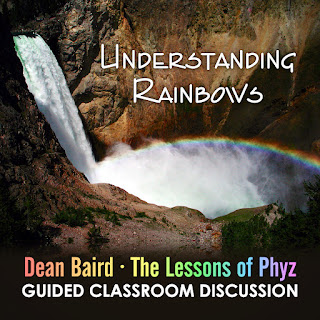
Understanding Rainbows [Springboard]

Second only to "Why the Sky is Blue" in ambition, I would rank this as one of the best lessons I have authored. 

With rainbows, the physics is relatively simple (once you've covered refraction and dispersion) and the geometry is simple. Putting them together? Well, this is a four-page lesson. It takes a bit of time to work out the details.

The post-lesson "extras" in the presentation are amusing rewards. The "Double Rainbow" video has mostly faded from cultural awareness among students, so it's new to them! Is the dramatic interpretation over the top? Yes it is.
Includes
Student document (print-friendly Google Docs file on Google Drive)
Instructional presentation (link embedded in answer key)
Answer key

Diversion into Dispersion [Lab Springboard]

This is an exploration of differential refraction: white light is dispersed into a spectrum by a prism. The activity explores the physics behind dispersion before giving a name to the phenomenon. 

Pink Floyd's classic album cover for Dark Side of the Moon is evaluated: what's right and what's wrong with the illustration? [I painted a 10' x 30' mural of Storm Thorgerson's image outside my physics classroom.]

Student document (print-friendly Google Docs file on Google Drive)
Instructional presentation (link embedded in answer key)
Answer key

Tuesday, May 24, 2022

Index of Refraction [Springboard]

Examples of vacuum, glass, and gallium phosphide are used as we define and apply the index of refraction. Ratios of speeds, wavelengths, and sines of angles are involved. Interesting graphical tangents are visited, and a numerical sample problem is included.


Includes
Student document (print-friendly Google Docs file on Google Drive)
Instructional presentation (link embedded in answer key)
Answer key

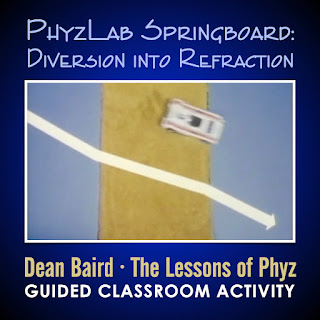
Diversion into Refraction [Lab Springboard]

This activity acts as an introduction to refraction. Prior knowledge: sound travels faster in solids (like steel) than it does in air. So what about light? Does it travel faster in transparent solids (like glass) than it does in air? Isaac Newton thought so.

We use the classic "car on carpet" model to explore the question. A toy car is rolled at an oblique angle down a ramp. There are hard surfaces, and there are carpeted surfaces. The direction of the car's path is affected by moving through the different surfaces.

Thursday, May 5, 2022

The Secrets of Quantum Physics

Professor of physics Jim Al-Khalili investigates the most accurate and yet perplexing scientific theory ever - quantum physics. The program's two episodes
stream on Amazon Prime. YouTube links have also been embedded in the text below and the titles in the student documents.

The history of and battle over quantum entanglement. Albert Einstein hated the idea that nature, at its most fundamental level, is governed by chance. Professor Jim Al-Khalili reveals how, in the 1930s, Einstein thought he'd found a fatal flaw in quantum physics because it implies that subatomic particles can communicate faster than light in defiance of the theory of relativity. Delightful bonus: "Tangled Up With You" by Eliza's Uncertainty, a perfect addition to your modern physics playlist.

Friday, April 29, 2022

Switch Wars [Design Lab]

Design Challenge:
Using only a battery, bulb, wires, and two single pole double throw switches, make a “three-way” switch. A three-way switch involves 2 two-position switches (like common light switches in houses). Either switch can be used to turn a light on or off. Such two-switch systems are often used for lights in stairways, long hallways, or for outdoor structures. Children (of varying ages) sometimes battle each other by stationing themselves at opposite switches; one tries to keep the light on while the other tries to keep it off.


Includes

Student document (print-friendly Google Docs file on Google Drive)

Answer key