Showing posts with label Conceptual Physics. Show all posts

Monday, July 22, 2024

Crosswords that work in college prep courses

Crossword puzzles are amusements appropriate for elementary school students. Middle school at tops. They sit at the base of Bloom's taxonomy, and have no place in a rigorous high school college prep course,

Or so I thought.

I don't even remember what my impetus was for creating a series of crossword puzzles for my college prep physic course, but create I did. Computer software meant I could load a list of words and the computer would craft a puzzle grid. Then I could add words to flesh out the puzzle and fill the page.

What I didn't expect was student enthusiasm for the puzzles. That enthusiasm acted as a catalyst, and I worked out an implementation scheme.

Sunday, September 10, 2023

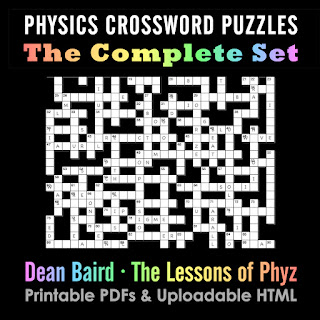
Physics Crossword Puzzles [Conceptual Physics]

Once I gained access to crossword puzzle creation software, I plied computer power to generate physics-themed puzzles. The trouble with most academic crosswords is that they consist one or two dozen words, not that many crosses, and a whole lot of empty "zen space". 

I was determined to fill the gaps on my physics crosswords with other terms, preferably science terms. When you get deep into gap-filling, you appreciate the value of short words, acronyms, and initialisms. Later I got the idea using words from online lists of "words all high school students should know". I knew that would bring some joy to the hearts of my ELA colleagues.

The puzzle-creation software package I initially used did not survive the 2000s. The most recent program I used still operates in the current version of the macOS operating system. So now I'm preparing crosswords for posting at TPT (Teachers Pay Teachers).

Puzzle Maker by Hokua Software LLC allows the creation of printable crosswords. It also allows for the creation of HTML puzzles that can be uploaded to one's server space and solved online. It also lets you drop in an image for the grid's backdrop rather than just using black, white, or gray. 

And for the printable PDF versions, I've prepared one with an empty grid, another with 10% of the letters prefilled, and another with 20% of the letters prefilled. Users can determine which level of difficulty is best for their students. I include a separate Word List for instructors to deploy at their own discretion. Words like "rarefaction" and "specular" are likely to show up where appropriate, as will high school vocab words like "impetuous" and "evanescent," so hints can prove useful.

I've discovered that there is much more craft involved in the creation of a robust, "busy" crossword puzzle, even with computer power. This is why so many subject-matter crosswords are so sparse.
Friday, January 1, 2010

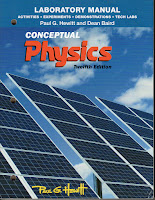
Conceptual Physics Lab Manual

After authoring (and/or wrangling) lab manuals for Conceptual Physical Science, Conceptual Integrated Science, Conceptual Physical Science Explorations, and Conceptual Integrated Science Explorations, I was invited to write a lab manual for Conceptual Physics, the grand daddy of the Conceptual Science family. 

I had no shortage of material. I had been writing labs for my own physics students since the 1980s. My constellation of influences included Paul Robinson, PRISMS, Dewey Dykstra, Jim Minstrell, Fred Goldberg, Lillian McDermott, Arnold Aarons, and many others. But I had my own vision of what made for a good lab activity, too.

Over the years, I concocted plenty of duds. But also many keepers. The keepers I polished each year based on classroom experience with real students.

Porting my own classroom labs over to lab manual labs was non-trivial. I authored my work in art/design software: Silicon Beach Software SuperPaint, then Deneba Canvas, then Apple Keynote. I prioritized art over text. But Pearson needed "camera ready copy" in Microsoft Word. Word had quirks to be wrestled with, and it was not a platform designed for creating exacting art. Personal touches and inside joke had to be stripped. But the core purpose and process was to be retained.

The lab manual for the 12th edition of Conceptual Physics was the last one Pearson asked for. It was the best one I wrote for the Conceptual Science team in terms of activity quality and textbook alignment. The 13th edition of Conceptual Physics was subsequently published without a corresponding lab manual.


Conceptual Integrated Science Explorations

Following the success of 2007's Conceptual Integrated Science for the college textbook market, Conceptual Integrated Science Explorations was produced for the school (7-12) market. It was published in 2010.

This title mirrored Conceptual Physical Science Explorations for the school market. The content once again added biology to physics, chemistry, and earth science.

Most of my work was to align the lab manual to the textbook in terms of the sequencing.

In 2017, Pearson sold its K-12 division but maintains its Higher Ed division.


Monday, January 1, 2007

Conceptual Integrated Science


Suzanne Lyons had a vision of expanding Conceptual Physical Science to include biology: Conceptual Integrated Science.

On Hewitt's Conceptual Science team, I was the lab manual author, so I was asked to handle the lab manual for this title.

But I was a mere high school physics teacher with a full-time job teaching physics. I had more than enough physics lab ideas, but I was already using John Suchocki's chemistry labs and Leslie Abrams' earth science labs in the Conceptual Physical Science titles. Biology labs? Not a chance. I was in over my head.

Suzanne contributed great earth science labs, and we outsourced biology labs from Anne Coleman. My contribution was formatting them and giving them the kind of whimsical titles so they matched the style of the manual.

I probably should have been credited as the lab manual wrangler. But in the wild world of publishing, that made me author of record.

The second edition lab manual ran into production difficulties and was a bit delayed, but it eventually saw the light of day. Of all the lab manuals I produced, this is the one best aligned to its corresponding textbook. I'm proud of that. It also seems to have lost its place in the Pearson catalogue. The 3rd edition of the Conceptual Integrated Science textbook has since been published without a lab manual.


Saturday, January 1, 2005

Paul Hewitt's Next Time Questions

Next-Time Questions are favorite insightful questions I have asked my students over my teaching career. I have embellished them with cartoons to catch interest. Their intention is to elicit student thinking. My use of them was posting several in a glass case outside my lecture hall—without answers. The wait-time for answers was one week. I could have called them Next-Week Questions, which would have been more appropriate.

Most of these have been published over the years as Figuring Physics in The Physics Teacher magazine. They have also been in ancillaries to my Conceptual Physics textbooks, and physical science textbooks as well. My hope is that teachers will pose the questions, and withhold answers to “next time,” which could be as early as the next class meeting. Their educational value is the long wait time!

Thursday, January 1, 2004

Conceptual Physical Science

As soon as Conceptual Physical Science Explorations was published, it was time to get to work on the 3rd edition of the college Conceptual Physical Science.

I could now use the CPSE lab manual as a foundation and bring more of my own labs into the project. The insanity of the tight CPSE timeline was no more. I was getting better at MS Word: learning how to work around its quirks and learning how to create diagrams with its art tools. The 3rd edition (my 1st edition on the team) was published in 2004.

The Conceptual Physical Science textbook did very well in the marketplace. Fourth and 5th editions followed in 2008 and 2012.

Hewitt became a regular at NSTA conferences in this era, and I joined him every chance I got. Pearson would typically schedule a session for him to promote the school (Explorations) Conceptual Science textbooks. Hewitt had me describe the nature of the lab manual within his session. I brought photos, and I brought demonstrations. The conferences were always a good chance to hang out with the Hewitts and catch up with friends at Arbor Scientific, Pasco, and PhET. I actually worked the PhET booth for several hours when NSTA came to San Francisco.

Wednesday, January 1, 2003

Conceptual Physical Science Explorations

How I Met Paul Hewitt
I attended my first Northern California and Nevada Section of the American Association of Physics Teachers meeting in the autumn of 1986 at American River College in Sacramento. Among the instructors doing Show & Tell that morning was Conceptual Physics author, Paul Hewitt.

There aren't many celebrities in the world of physics teachers, but Paul Hewitt was one. His Conceptual Physics textbook had been growing in popularity at colleges since 1971, and the then-new Conceptual Physics: A High School Program was in the process of shaking up the high school physics textbook market.

But there was Hewitt, just another person in the queue to present a demonstration to the NorCal family of physics instructors. I did my best to play it cool.

In 1989, the AAPT's Summer Meeting was in San Luis Obispo. This was my first national meeting. One day at lunch, I found myself across the table from Hewitt and we chatted it up, but I gave him no reason to remember me.