What world will we live in tomorrow as climate change reshapes the Earth? Our planet has many surprises in store. This series reveals nature's astonishing adaptation abilities, and how we humans can become a supporting force.
Four people on four continents face environmental change driven by climate change. As resources grow scarce, they witness shifts in wildlife behavior. Each actively seeks solutions to adapt and prevent conflict between humans and wildlife.
Four people on four continents face environmental change driven by climate change. As resources grow scarce, they witness shifts in wildlife behavior. Each actively seeks solutions to adapt and prevent conflict between humans and wildlife.
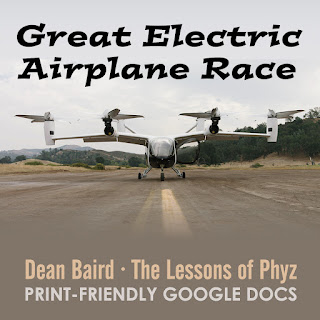
Miles O'Brien was our host for the popular NOVA episode, Chasing Carbon Zero. A few years ago, he put this episode together. O'Brien is a pilot who owns a plane he enjoys flying. Aviation presents an especially acute problem in our efforts to decarbonize transportation. This is the story of those who thrive on this acute engineering problem. Impressive innovations are being made. But progress is hard-earned, and there seems to be a long runway ahead of us before this technology can truly take flight. [You know I wouldn't be able to resist.]
Our Planet (2019) represented something new in the well-traveled wildlife documentary genre. It included stunning photography and footage acquired at considerable expense and difficulty; that's the price of admission. But David Attenborough's script did not shy away from revealing the less appealing facts of habitat and species decline. The realities of human impact were documented. Not heavy-handidly. But not ignored, either.
This follow-up miniseries centers on migrations and seasons. Well, months more than seasons as it trots the globe's northern and southern hemispheres throughout one calendar year. It's perhaps a bit gentler regarding the message of anthropogenic climate change, because that science is very settled. Our Planet II was designed with bingers in mind. Each of the first three episodes ends in a cliffhanger.
Climate journalist, Miles O'Brien, takes us on a journey whose destination is "Net Zero" carbon. That's where we're supposed to be by 2050 to avoid a range of climate-related catastrophes. Those catastrophes are starting to show themselves here in 2023, so the need is clear.
As with Weathering the Future, this documentary doesn't waste time making the case that climate change is happening. That's settled science. It's documented elsewhere in the world of documentaries.
This program is devoted to the nuts and bolts of how we get from here to carbon zero. It's a difficult, but not impossible task. For some key carbon contributors, innovation is no longer needed. We have the tools we need. But we need to implement them.
We're turning a corner in climate change documentaries. There is a rich canon of warning-themed documentaries, which saw prominence with An Inconvenient Truth (2006) through Before the the Flood (2016).
Now we are documenting human responses to climate change. NOVA's Weathering the Future stands as a solid example. It doesn't spend time presenting the science establishing climate change. It understands that climate change is a reality that is having concrete consequences in communities right now. It spends its time detailing community responses to climate change impact.
Once upon a time, I arranged six Earth science-based bundles filled with question sets for documentaries from NOVA, National Geographic, BBC, PBS, and The Universe. Since then, I've added many, many new titles. So I've updated those bundles with the new titles.
For maximum flexibility, get them all: A Megabundle of Science: EARTH · ENVIRONMENTAL · ASTRONOMY at TPT. It's updated so frequently, you'll need to click the link to see how many resources currently in the bundle. It's more than 55!
When teaching the topics listed below, take a look at these bundles. You might find something you'll like.
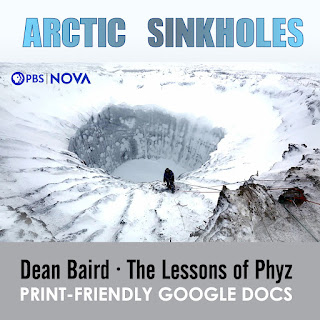
If you've been feeling that climate \change has been running ahead to schedule, there may be a reason for that. This episode of NOVA lays it out. Spoiler alert, it's permafrost thaw and perhaps fossil methane chimneys.
"Thawing permafrost, right now on NOVA" apparently doesn't attract Viewers Like You, so producers looked for a sexier hook. What they found was arctic sinkholes, first seen in Russia's Yamal peninsula. At first glance, maybe large-scale, remote versions of sinkholes like those that have been swallowing cars around the world. Nope. These are explosion craters surrounded by debris fields. The calls are coming from inside the house. "Arctic sinkholes, right now on NOVA." Now we've got an episode.
The focus of the program is nevertheless permafrost thaw and the investigation of an ongoing release of ancient methane previously deemed safely sequestered. Nontrivial new greenhouse gas emissions that were not accounted for in the 2015 Paris Accords. So yeah, it's worse than we thought.
Professor Iain Stewart examines the role of geology in the history of mankind in this documentary program. Each of the classical elements plays a role - for instance, he points out that mankind has been drawn to fault lines for centuries, since this is the best place to find minerals, oil, soil suitable for farming, etc. But with these riches comes great danger, of course, since locating communities on the fault lines makes them vulnerable to earthquakes. Subsequent episodes review the cycle of freshwater, the force of the wind, and fire both as a source of energy and a terrifying force of nature. From crystal caves in Mexico to holes in the Iranian desert and a mysterious lake in Oregon, Stewart travels the globe to hammer his point home.
1. DEEP EARTH | Beneath the Crust In this first episode, Iain explores the relationship between the deep Earth and the development of human civilisation. He visits an extraordinary crystal cave in Mexico, drops down a hole in the Iranian desert and crawls through 7,000-year-old tunnels in Israel.
His exploration reveals that throughout history, our ancestors were strangely drawn to fault lines, areas which connect the surface with the deep interior of the planet. These fault lines gave access to important resources, but also brought with them great danger.
Share the wonder of the extraordinary place we call home. Utilizing the latest technology Our Planet was filmed entirely in Ultra High Definition in over 50 countries. From exotic jungles to the deepest seas, open your eyes to the connections we all share.
1. ONE PLANET The habitats that make up our planet are connected and reliant upon each other. The astonishing diversity of life on earth depends on these global connections. Witness the planet's breathtaking diversity—from seabirds carpet-bombing the ocean to wildebeests eluding the wild dogs of the Serengeti.
2. FROZEN WORLDS Our poles are some of the earth's last remaining wildernesses. And yet just as we are beginning to understand these extraordinary places, they are changing fast. On the unforgiving frontier of global warming, polar bears, walruses, seals and penguins find their icy Edens in peril.
National Geographic · 2014 · Presenter: Neil deGrasse Tyson
Cosmos: A Spacetime Odyssey, is a thirteen-part American science documentary television series released in 2014. The show is a follow-up to the 1980 television series Cosmos: A Personal Voyage, which was presented by Carl Sagan is considered a milestone for scientific documentaries. This series was developed to bring back the foundation of science to network television at the height of other scientific-based television series and films. The show is presented by astrophysicist Neil deGrasse Tyson, who, as a young high school student, was inspired by Sagan.
1. STANDING UP IN THE MILKY WAY Tyson opens the episode to reflect on the importance of Sagan's original Cosmos, and the goals of this series. He introduces the viewer to the "Ship of the Imagination", the show's narrative device to explore the universe's past, present, and future. Tyson takes the viewer to show where Earth sits in the scope of the known universe, defining the Earth's "address" within the Virgo Supercluster. Tyson explains how humanity has not always seen the universe in this manner, and describes the hardships and persecution of Renaissance Italian Giordano Bruno in challenging the prevailing geocentric model held by the Catholic Church. To show Bruno's vision of the cosmic order he uses an animated adaptation of the Flammarion engraving, a 19th century illustration that has now become a common meme for the revealing of the mysteries of the Universe.
The episode continues onto the scope of time, using the concept of the Cosmic Calendar as used in the original series to provide a metaphor for this scale. The narration describes how if the Big Bang occurred on January 1, all of humankind's recorded history would be compressed into the last few seconds of the last minute on December 31. Tyson concludes the episode by recounting how Sagan inspired him as a student as well as his other contributions to the scientific community.
Science teachers have an obligation to instill critical thinking and skepticism in their students. If my students can calculate kinetic energy as (1/2)mv^2 but also buy a Power Balance bracelet or accept media reports of paranormal activity, I feel I have failed them.
So I insert explicit lessons in skepticism and critical thinking into the curriculum throughout the school year. My hope is that such lessons strengthen students' thinking skills I'm the classroom and (more importantly) beyond. I developed these activities for use with my own students.
Can psychics predict the future? Many people seem to think so. Others argue that, in most cases, so-called psychic experiences are really misinterpretations of events. In this episode of NOVA, magician and confirmed skeptic James Randi challenges viewers to weigh the evidence for and against the existence of psychic phenomena.
2. MERCHANTS OF DOUBT
A documentary that looks at pundits-for-hire who present themselves as scientific authorities as they speak about topics like toxic chemicals, pharmaceuticals and climate change.
Cosmos: A Personal Voyage is a thirteen-part television series that covers a wide range of scientific subjects, including the origin of life and a perspective of our place in the universe.
I turned 16 while this series aired, and was completely captivated by it. My father had been a fan of Bronowski's Ascent of Man and Burke's Connections. Those were outstanding series in their own rights. But I was all about astronomy, and Sagan's journey resonated with me.
Sagan's Cosmos aged very well and is still regarded as among the best science miniseries ever produced. And as WIRED noted, Sagan's still right all these years later.
The way I used Cosmos was as a "chill day" between units in Physics. For my students, and for me. We all needed it. I kept their question sets after each episode. At the end of the year, I'd give them their sets back and they could use them on a "Cosmos Unit Test". Easy with the completed question sets; challenging without. Definitely among my longest "delayed gratification" activities.
1. THE SHORES OF THE COSMIC OCEAN Carl Sagan opens the program with a description of the cosmos and a "Ship of the Imagination" (shaped like a dandelion seed). The ship journeys through the universe's hundred billion galaxies, the Local Group, the Andromeda Galaxy, the Milky Way, the Orion Nebula, our Solar System, and finally the planet Earth. Eratosthenes' successful calculation of the circumference of Earth leads to a description of the ancient Library of Alexandria. Finally, the "Ages of Science" are described, before pulling back to the full span of the Cosmic Calendar. Note: the revised version of the series adds an introduction by Ann Druyan to this episode, recorded after Sagan's death, in which she discusses some of the changes that occurred in the years after its broadcast.This episode emphasizes astronomy: from the universe to the round Earth.