Sunday, March 6, 2022

Inertia in Action [Virtual Demonstration]

The activity began as a stations lab before the pandemic. It was repurposed as a demonstration for remote teaching/distance learning (RT;DL). The stations are

Card Trick
A card is laid across the top of a cup. A coin is placed on top of the cup. Get the coin in the cup without leaving fingerprints on the card.

Hoop Dreams
An embroidery hoop is balanced above a tube (such as an air core solenoid). A marker pen is balanced on top of the hoop. Get the marker into the tube in one fell swoop.

Friday, March 4, 2022

Moving Sources [Virtual Demonstration]

Video clips from classic PSSC and other films are used here to show what happens when a wave source is moving while it makes waves. [Sourced from
Ztek's Physics: Cinema Classics.]

It is recommended that you work through the included (linked) presentation with the answer key in hand (practice) before showing this in class. The activity should be guided by the instructor.

There are some nice multimedia clips at the end and a Big Bang bonus after the end credit slide, where Sheldon attends a Halloween party dressed as the Doppler effect.


Given the variety of video assets used in the linked presentation, this is another Fair Use freebie.

I added this one to the Bundle of Phyz: WAVES AND SOUND.

Bell Jar [Virtual Demonstration]

In space, no one can hear you scream.

We put the famous tagline from Alien to the test in this demonstration. It's the classic bell jar in which a bell in a bell jar is subjected to a high vacuum as we listen for the sound.

The Encyclopedia Britannica Education Corporation's (EBEC) "Learning About Sound" 2nd Edition, 1974 filming of this demonstration was masterfully executed. 

  • Smoke is added to the bell jar prior to evacuation so that the air can be seen. And that smoke is thick! When it's gone, the air is essentially gone.

Thursday, March 3, 2022

A Bundle of Phyz: MOTION

Motion may be the most overrated topic in introductory physics. It is often the first topic covered in the course, and in some courses, the pure study of kinematics can linger from August through September and deep into October. That struck me as excessive, but any physics course is largely the story as told by the instructor.

The bundle begins with perhaps the first Conceptual Physics Alive! lecture filmed, "Linear Motion". Groundwork is laid as terms are defined and examples are provided.

"Motivating the Moving Man" is a PhET-fueled sim lab that focuses on translating motion graphs into verbal descriptions and verbal descriptions into motion graphs.

Wednesday, March 2, 2022

The Great Bullet Race [Virtual Demonstration]

A demonstration of the independence of vertical and horizontal motion in projectiles.

As the pandemic rolled from the spring of 2020, through the summer, and on into the fall, I started working on ways to move classic demos and labs into the realm of remote teaching/distance learning (RT;DL as I cleverly recoined the popular TL;DR abbreviation).

The Great Bullet Race was an early effort. I wrote about it on The Blog of Phyz.

I used a clip from an old Physical Sciences Study Committee (PSSC) film, "Free Fall and Projectile Motion" (1960), as restored by Ztek in Physics: Cinema Classics (P:CC).

Blowout Kinematics [Virtual Demonstration]

In which I blow a whiteboard marker through an aluminum tube and use photogates connected to a timer and simple rulers to collect kinematics data. Calculating muzzle velocity, acceleration, time-in-tube, and "halftime distance" takes us on a tour of the algebraic equations of motion.

I use this in my AP Physics 1 course.

Here's the story of how I adapted it for remote teaching; distance learning (RT;DL), as told on The Blog of Phyz.


My blowgun-based curriculum goes back... way back.

Tuesday, March 1, 2022

A Bundle of Phyz: NUCLEAR PHYSICS

Segment 4 of Physics of the Universe (the NGSS Three-Course Model physics course) is all about nuclear physics. There are only six segments for the whole course, and one of them is nuclear. I don't know about you, but I know I wasn't going hard at nuclear physics in my regular physics course prior to Physics of the Universe.

The bundle opens with a question set for Conceptual Physics Alive's "Radioactivity," followed by a PhET-fueled fun activity, "Radioactive Speed Dating" for some quick radiometric dating practice. 

Sunday, February 27, 2022

A Bundle of Phyz: ATOMIC PHYSICS

This bundle begins with Paul Hewitt's homage to atoms, followed by
The Mechanical Universe episode, "The Atom." Different perspectives, indeed.

"The Photoelectric Effect" Lab Springboard utilizes a few videoclips and PhET's The Photoelectric Effect sim to introduce this surprising topic.

"Fantasia on the Photoelectric Effect" provides a mechanical model to help understand the phenomena.

For a more quantitative look into the photoelectric effect, "Shine a Light" uses PhET's Photoelectric Effect sim. Students collect data, calculate key quantities, and plot results.

Thursday, February 24, 2022

A Bundle of Phyz: STARS + THE BIG BANG

This might seem like a bit of a detour from the more traditional physics topics covered in the previous bundles. But "Stars and the Origin of the Universe" is Segment 6 of Physics of the Universe in the NGSS Three-Course Model. And there are no Conceptual Physics Alive or Mechanical Universe episodes in this realm.

This bundle opens with NOVA's "Secrets of the Sun," and The Universe's "Life and Death of a Star." We close our stories of stars with NOVA's "Universe Revealed: Age of Stars".

Wednesday, February 23, 2022

A Bundle of Phyz: LIGHT AND COLOR

As fortune would have it, there are many Phyz things involving light and color.

The bundle opens with an encyclopedic "Tour of the Electromagnetic Spectrum," produced by NASA. Next up is a look at a 2008 viral ad campaign, "Cell Phone Popcorn". Popping corn with phones was an urban legend in the early days of smartphones. 

Next up is a colorful sequence. "Pixel Peeping" and "Fun With Colors" were originally written for in-person instruction, but modified into Virtual Labs for remote teaching/distance learning (RT;DL). Conceptual Physics Alive's "Light and Color" follows nicely. Then a pair of color mixing YouTube Physics lessons explore cephalopod camouflage and the mystery of magenta. How much do you know about chromatophores?

Tuesday, February 22, 2022

A Bundle of Phyz: WAVES AND SOUND

Waves: it's difficult to communicate without them. I consider them to be fundamental to the study of physics. 

This collection opens with two PhET-fueled experience-builders, "Water Waves in an Electric Sink" and "High Quiet Low Loud". It continues with video lessons from Conceptual Physics Alive "Vibrations and Sound I" and "Vibrations and Sound II," with The Mechanical Universe episode, "Waves" in between. It ends with the BBC's somewhat metaphysical examination of waves and their intrinsic ephemeral nature, "The Secret Life of Waves".

Monday, February 21, 2022

A Bundle of Phyz: ELECTROMAGNETISM

Upon posting the RT;DL Virtual Lab Experiments related to electromagnetism, I realized I had a bunch of resources on that topic. So I created a bundle to gather and discount them.


The bundle includes the Virtuals: "Seeing Magnetic Fields," "Ørsted's Discovery," "Electric Magnetism," and "Magnetic Electricity," YouTube Skepticism: "Magnet Boys," The Mechanical Universe: "Magnetism," "Magnetic Fields," and "Electromagnetic Induction," Conceptual Physics Alive: "Magnetism and Electromagnetic Induction," NOVA's "Magnetic Storm," and BBC's Shock and Awe: Part 2. "The Age of Invention." All the resources in the bundle are available separately. And they're all print-friendly Google Docs files to accommodate whatever kind of teaching you're doing at the moment.

There's also a link to the activity I wrote for PhET's Faraday's Electromagnetic Lab. It's free on PhET's activities list for the sim as a PDF file.

This is a big bundle. As was the case in the electrostatics bundle, there were some resources that struck me as related to, but not central to introductory electromagnetism. I listed them in the product description for anyone keen to even dive deeper into this topic. 

Fun With Colors [PhET]

Once I saw how much students enjoyed exploring colors with Pixel Peeping, I thought I'd take that curiosity a step further with an add-on activity that didn't require any materials beyond the means of running PhET's Color Vision simulation.

Running this in-person required my first distribution of color copies. I printed the student documents in quantity on my color laser printer at home until I was able to secure a color laser printer for my classroom. Unfortunately, there came a time when the school's principal decided to wage war on the cost of printing done by teachers and rejected all in-room printing supply requests. So I had the printer, but no more toner. And no more printed pages. I trust the savings were worth it.

In any case, "Fun With Colors" is quirky and brief, so I posted it as a freebie.

Sunday, February 20, 2022

Pixel Peeping [PhET+Virtual Lab]

Students have been looking at screens too much for about two years. Some would say it's been longer than that. But have they really looked at those screens? Up close? "Pixel Peeping" asks them to do just that.

For the in-person version, we used pocket magnifiers to examine the pixel structure on our classroom laptop LCD screens. We protected the screens from the magnifiers with sheets of transparency film. (You remember transparencies, right? And carbon paper, film canisters, telephone cords, ...)

PhET's Color Vision sim is activated. The activity begins innocently enough with microscopic inspections of red, green, and blue. Things take a turn when white is examined, and go off the rails with yellow. 

Brainiac Electric Fence [Virtual Demonstration]

This was a video demo to begin with. So it was half-way virtual already. To maximize its utility, I needed to chop this Brainiac: Science Abuse segment up and intersperse questions. The physics is nice in that it ranges from fundamental up to “beyond the scope of this introductory course”. From conductors and insulators, through series circuits, to R-2R resistor ladders. This is a nice lesson to put near the end of a circuits unit. 

Since I remixed the segment (really just chopped it up), I'm posting this as a Fair Use freebie. 


Includes:
Student document (print-friendly Google Docs file)
Observation Presentation (HTML link embedded in and URL printed in student document)
Answer key (Google docs file)

Saturday, February 19, 2022

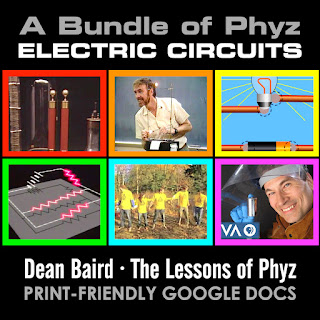
A Bundle of Phyz: ELECTRIC CIRCUITS

The bundle begins with The Mechanical Universe's "The Battery," since batteries often power the simple DC circuits we like in Physics.

Next it's the PhET-fueled "Batteries and Bulbs". Originally written as a hands-on lab activity, this version was redesigned for use in remote teaching/distance learning (RT;DL).

Conceptual Physics Alive's "Electric Circuits" is Paul Hewitt's take on the matter; The Mechanical Universe's "Electric Circuits" is David Goodstein's. Both are excellent.

Britain's Brainiac: Science Abuse serves up an engaging and offbeat take on electric circuits with humans acting as the resistors in "Electric Fence". Some will recognize host Richard Hammond from Top Gear, etc.

We return to the battery and update its story with David Pogue's PBS/NOVA episode, "Search for the Super Battery".

Then we have "Logic Gates," in which Boolean algebra is played out in circuit form as students design simple circuits with switches that will turn a bulb on under specific conditions. To prepare students for Boole and truth tables, a gentle pre-lab worksheet has them drawing up gate configurations that allow a cow access to a pasture under specific conditions.

Once students master the single pole single throw (STSP) switches of "Logic Gates," they might want to have a go at designing a three-way switch, which involves SPDT (single pole double throw) switches.


All resources are available separately. All are print-friendly Google Docs files on Google Drive. All include answer keys.

If the shorter High School Adaptations of The Mechanical Universe are more your style, then check out Set 6: Circuits and Magnetism.

If you didn't work Shock and Awe - Part 1: Spark into your electrostatics lessons, that episode still works well with electric circuits.

Friday, February 18, 2022

High Quiet Low Loud [PhET]

Distinguishing between amplitude and frequency with mechanical waves is a lesson that lends itself to a computer activity that allows students to modify wave forms. When students can see a visual representation of a sound wave while listening to the wave, and then manipulate the amplitude and/or frequency of the source, the distinctions tend to stick.

PASCO's Waveport plugin for DataStudio provided a great vehicle for such an exploration. But times change and PASCO has moved on to the powerful Capstone and flexible SPARKvue applications.