Neuroscientist David Eagleman explores the human brain in an epic series that reveals the ultimate story of us, why we feel and think the things we do. This ambitious project blends science with innovative visual effects and compelling personal stories, and addresses some big questions. By understanding the human brain, we can come close to understanding humanity.
Monday, June 26, 2023
Monday, June 19, 2023
Our Planet II
This follow-up miniseries centers on migrations and seasons. Well, months more than seasons as it trots the globe's northern and southern hemispheres throughout one calendar year. It's perhaps a bit gentler regarding the message of anthropogenic climate change, because that science is very settled. Our Planet II was designed with bingers in mind. Each of the first three episodes ends in a cliffhanger.
Saturday, June 10, 2023
Colosseum: Roman Death Trap
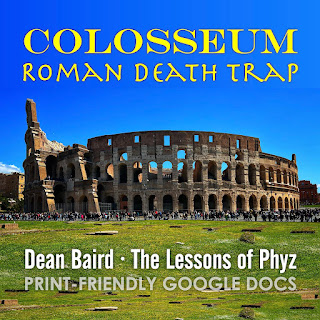
This episode of NOVA popped up as this week's summer rerun for NOVA. I visited the Colosseum in April and saw a lift made of lumber in the bowels (hypogeum) of the structure. This program tells its story, and much, much more. As the title implies, it was not a place of joy, mirth, or happiness for those who participated in the spectacles.
But there was state-of-the-art engineering going on in there. So ... I don't know who needs to use this, but there is cromulent STEM content in this episode: mechanical and hydraulic engineering as well as emission spectroscopy and bone-strengthening nutritional supplements for gladiators. Gladiators were trained in fight schools and were provided with health care. Not all gladiator fights were allowed to end in a death (given the investments in these fighters). But releasing wild apex predators into the arena via lifts and trap doors kept audiences coming back for more.
Crypto Decoded

NOVA traces the origins of crypto and what some hoped it might be able to do. From the blockchain to Ethereum, this episode does what it can to decode crypto.
From Bitcoin to NFTs, crypto is making headlines. But what exactly is it, and how does it work? Experts go beyond the hype and skepticism to unravel the social and technological underpinnings of crypto – exploring how it came to be and why this new technology may change more than just money.
Sunday, June 4, 2023
Honda Cog Ad
I always loved this two-minute ad from Honda UK. It merited an exhaustive Wikipedia entry. I showed it during our Energy units, since there were so many energy transfers and and transformations. Creating a student assignment around it was challenging, though. And doing so sat on the back-burner for some time.
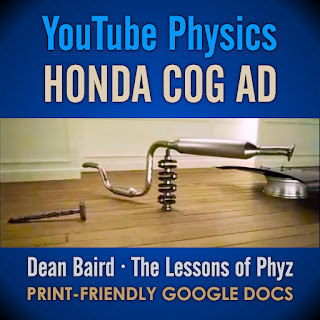 Eventually I settled on a "phenomena-match" where I created a list of physics phenomena and broke the video into 33 distinct events, with titles!
Students are asked to read the list of phenomena and then watch the video. Then they're asked to watch the video again and label each event with at least one phenomenon shown. (Some events show multiple phenomena, and students are encouraged to label as many as they see.)
But there are some restrictions. All 33 events need to tagged with at least one phenomenon, and each phenomenon must be assigned to at least one event by the end of the video. And no single phenomenon can be assigned to more than five events.
Fun, engaging, and with just a pinch of tension (as you come up on your fifth citation of "collision").
Saturday, June 3, 2023
Spin the Cradle

Center that cradle on a low-friction turntable, and you've got the makings of a nice demonstration for AP Physics 1. There's a classic uniform circular motion free-body diagram to be solved. And the solution speaks to the angle a ball will swing to when things are set into motion.
A curious counter-intuitive interpretation of the mathematics is explored. It's nerdy stuff, appropriate for the more deeply-set plow we use in the advanced level high school course.
And how cool is that cover photo, with the balls of the cradle seeming to repel one another?
Thursday, June 1, 2023
Secrets in Our DNA

My immediate take was that the more you knew about DNA, the less likely you were to buy into these tests.
I haven't purchased a test, myself. But I might get one someday. There seems to be some entertainment value and some medical value. But it's important not to set expectations very high.
That said, there is a story here. A story with several compelling threads. And this episode of NOVA gets at this story.
Thursday, May 25, 2023
Your Brain: Perception Deception + Who's In Control?
It seems there was a moment a few years ago when our collective senses of reality were universally called into question. I am speaking, of course, about The Dress. Was it blue and black or white and gold? [Disclosure: I was on Team White and Gold in the moment.] And then ... was it Yanny or Laurel? [I only hear Yanny.]
And one that I seem to have repressed: "Brainstorm" or "Green Needle"? That one added a new dimension of terror as your own brain could be flipped from Brainstorm to Green Needle by mere suggestion. The audio didn't change; your brain's interpretation changed. [Update: you can also roll with "Brain Needle" or "Green Storm" if you ... put your mind to it.]
Our faith in the fidelity of the realities our minds create around us turns out to be somewhat misplaced. This two-part series investigates that and more.
Nearly a hundred of the Exploratorium's Science Snacks involve perception. [Snacks can be sorted by subject; one of those subjects is "perception".]

Is what you see real? Join neuroscientist Heather Berlin on a quest to understand how your brain shapes your reality, and why you can’t always trust what you perceive. In the first hour of this two-part series, learn what the latest research shows about how your brain processes and shapes the world around you, and discover the surprising tricks and shortcuts your brain takes to help you survive.

Are you in control, or is your brain controlling you? Dive into the latest research on the subconscious with neuroscientist Heather Berlin. Sleepwalking, anesthesia, game theory, and more reveal surprising insights in this eye-opening journey to discover what’s really driving the decisions you make.
Bonus NOVA content: What Illusions Tell Us About Our Brains
If you have ever encountered an utterly bewildering illusion, you know the powerful effect such images have on the mind. If we can't trust what we see, then what is reality? In this virtual field trip, Professors. Susana Martinez-Conde and Stephen Macknik will present a smorgasbord of mystifying illusions selected from their Best Illusion of the Year Contest. Martinez-Conde and Macknik, who study the intersection of neuroscience, illusions, and stage magic, will explain just why we think we see the things we see.
Friday, May 12, 2023
Conceptual Physics Alive! is now streaming freely
Great news, physics types!
For your professional development, your classroom, or for your own delight, Paul Hewitt's classic CPAlive! lectures are gifted to you here for streaming or download. Enjoy! To learn more about Paul's latest (2023) "Conceptual Academy Physics" full high school program, visit ThePocketLab.com. Good Energy!
Conceptual Physics Alive! [A handy index page with links to episodes and question sets]
Saturday, May 6, 2023
Physics for the 21st Century

This might be something nice for after the AP exams in your AP Physics course. High school physics content was developed in the 17th-20th centuries. This series gets you past 1927.
Thursday, May 4, 2023
Chasing Carbon Zero

Climate journalist, Miles O'Brien, takes us on a journey whose destination is "Net Zero" carbon. That's where we're supposed to be by 2050 to avoid a range of climate-related catastrophes. Those catastrophes are starting to show themselves here in 2023, so the need is clear.
As with Weathering the Future, this documentary doesn't waste time making the case that climate change is happening. That's settled science. It's documented elsewhere in the world of documentaries.
This program is devoted to the nuts and bolts of how we get from here to carbon zero. It's a difficult, but not impossible task. For some key carbon contributors, innovation is no longer needed. We have the tools we need. But we need to implement them.
Monday, April 24, 2023
Weathering the Future

Now we are documenting human responses to climate change. NOVA's Weathering the Future stands as a solid example. It doesn't spend time presenting the science establishing climate change. It understands that climate change is a reality that is having concrete consequences in communities right now. It spends its time detailing community responses to climate change impact.
Thursday, April 6, 2023
Big Links Pages
Really just an excuse for me to post a favorite shot from Brooks Falls, Katmai, Alaska a few years ago. Arctic Lynx.

In any case, I always found some utility in big pages of links for video series. Links to videos (where possible) and question sets. So I made some for video series in various content areas. Here's what I've got.
A Personal Voyage [Carl Sagan 1980: 13 episodes]
A Spacetime Odyssey [Neil deGrasse Tyson 2014: 13 episodes]
Possible Worlds [Neil deGrasse Tyson 2020: 13 episodes]
Chemistry: A Volatile History [Jim Al-Khalili: 3 episodes]
Hunting the Elements ... Beyond the Elements [David Pogue]
Chemistry: Challenges and Solutions [13 episodes]
The World of Chemistry [Roald Hoffmann: 26 episodes]
How Earth Made Us | How the Earth Changed History [Iain Stewart: 5 episodes]
Earth Revealed: Introductory Geology [26 episodes]
The Habitable Planet: A Systems Approach to Environmental Science [13 episodes]
I'll keep these lynx links over in the bar on the right.

Wednesday, April 5, 2023
New covers for YouTube Physics and Skepticism
When I began cobbling together curriculum resources for my nascent TPT Store, The Lessons of Phyz, I was in a bit of a hurry. I was keen to populate the store with more than just Mechanical Universe question sets. So I added the YouTube Physics and YouTube Skepticism lessons I had developed over the years.
My product covers early on were fairly simple. By design (!). I wasn't a fan of ... what seemed like the universal TPT product cover look, which struck me as having a very K-6 aesthetic. I learned that this had something to do with Canva, a design tool favored by many TPT author-creators.
The covers I designed were a bit quieter/more mature. Maybe even boring. So I went back to these products and redesigned the covers. Since they were video-based, dropping in a few freeze-frame screen-shots seemed like a way to provide some previews.
Play the movie to see the new covers. Go full screen to enjoy the full effect. They are much more fun than the old covers.
Saturday, April 1, 2023
The Big Page of Chemistry
When The Mechanical Universe series was posted to YouTube, I constructed an HTML page to index the episodes. Then I added the High School Adaptations and links to my TPT question sets. Now I've got a comprehensive The Mechanical Universe of Phyz web page that I found to be quite useful.
Now that I've created question sets for four series concerning Chemistry, I thought a Big Page of Chemistry might be in order.
Here's the link to the page: Chemistry
The series indexed (from fewest to most episodes) are
Chemistry: A Volatile History (with Jim Al-Khalili)
This BBC mini-series has been my best-selling chemistry series.
Hunting the Elements and Beyond the Elements (with David Pogue)
David Pogue is always kinetic and entertaining. Hunting is a two-hour special; Beyond was the decade-later mini-series sequel.
Chemistry: Challenges and Solutions (with a variety of host researchers)
Thirteen half-hour episodes cover many major topics in chemistry. And demonstrations are woven in nicely.
The World of Chemistry (with Roald Hoffmann)
Twenty-six half-hour episodes provide comprehensive coverage of chemistry topics. First aired in 1990, and the years have not been kind to it. The Mechanical Universe has aged much more gracefully. But the academic content is solid. Series demonstrator, Don Showalter, is always great fun.
Thursday, March 16, 2023
The World of Chemistry
Produced after The Mechanical Universe and before Earth Revealed, The World of Chemistry with Roald Hoffmann debuted on PBS in 1990. Chemistry Nobel laureate, Roald Hoffmann hosts and Don Showalter is the series demonstrator in this series consisting of 26 half-hour episodes.
I've bundled the question sets into four series. A megabundle combines all the series is available, as are each of the individual episodes.
This series is not as polished or timeless as The Mechanical Universe, nor has it aged as well. But you might find some gems here that fit nicely into a well-balanced Chemistry, AP Chemistry, or Chemistry of the Earth Systems curriculum. And at 26 episodes, it's fairly comprehensive.
And for something with more contemporary sensibilities, check out Chemistry: Challenges and Solutions.
Friday, March 10, 2023
Earth Science: The Bundles (with Environmental Science)
[Updated April 2023]
Once upon a time, I arranged six Earth science-based bundles filled with question sets for documentaries from NOVA, National Geographic, BBC, PBS, and The Universe. Since then, I've added many, many new titles. So I've updated those bundles with the new titles.

For maximum flexibility, get them all: A Megabundle of Science: EARTH · ENVIRONMENTAL · ASTRONOMY at TPT. It's updated so frequently, you'll need to click the link to see how many resources currently in the bundle. It's more than 55!
When teaching the topics listed below, take a look at these bundles. You might find something you'll like.
Thursday, March 9, 2023
The Habitable Planet

It was produced by the Harvard Smithsonian Center for Astrophysics in association with the Harvard University Center for the Environment in 2007. It's described as a course intended for instructors. The vocabulary level is fairly high, but I think it could be used with students in AP Environment Science courses.
The question sets for the half-hour episodes run from 24 to 26 questions each. Episode 1: Many Planets, One Earth pairs nicely with Cosmos: Possible Worlds Episode 2: The Fleeting Grace of the Habitable Zone.
Friday, February 24, 2023
New Eye on the Universe

Now in February, 2023, New Eye on the Universe has aired. It follows the series of researchers putting JWST to work. The search for carbon dioxide in the clouds of a distant Jupiter-like exoplanet reveals a surprising molecule. The search for an atmosphere on a less distant rocky exoplanet pushed JWST to the limits of its capabilities.
Meanwhile, the water plumes of Enceladus and the surface of Europa yield some surprises. JWST provides stunning new images of Jupiter and Neptune. And the race to find the oldest galaxies in the universe cast current astronomical theories into doubt. There's even a nice vignette on how these infrared light images are colorized.
I didn't waste much time developing a Lessons of Phyz question set for this episode.
Monday, February 20, 2023
Star Chasers of Senegal

In Senegal, we see imams reacting to the application of modern astronomy techniques to the practices of Islam, Muslims using astronomy to determine true solar time, and evidence of astronomy used in ancient stone circles.
If you're looking for a nice addition to your Diversity, Equity, and Inclusion resources, take a look at PBS NOVA's Star Chasers of Senegal.
Subscribe to:
Posts (Atom)