In Pandemic: How to Prevent an Outbreak, we meet the heroes on the front lines of the battle against influenza and learn about their efforts to stop the next global outbreak.
1. IT HUNTS US In this introduction to life on the front lines, doctors in the U.S. and Asia battle the flu, and researchers race to develop a universal vaccine.
2. PANDEMIC IS NOW Vaccine debates rage while health-care workers inoculate against the Ebola virus in Congo and influenza in detainee camps at the U.S.—Mexico border.
3. SEEK, DON’T HIDE Worldwide, scientists test animals and their handlers for emerging viruses. In the U.S. and India, doctors work long hours caring for flu patients.
Science teachers have an obligation to instill critical thinking and skepticism in their students. If my students can calculate kinetic energy as (1/2)mv^2 but also buy a Power Balance bracelet or accept media reports of paranormal activity, I feel I have failed them.
So I insert explicit lessons in skepticism and critical thinking into the curriculum throughout the school year. My hope is that such lessons strengthen students' thinking skills I'm the classroom and (more importantly) beyond. I developed these activities for use with my own students.
Can psychics predict the future? Many people seem to think so. Others argue that, in most cases, so-called psychic experiences are really misinterpretations of events. In this episode of NOVA, magician and confirmed skeptic James Randi challenges viewers to weigh the evidence for and against the existence of psychic phenomena.
2. MERCHANTS OF DOUBT
A documentary that looks at pundits-for-hire who present themselves as scientific authorities as they speak about topics like toxic chemicals, pharmaceuticals and climate change.
Cosmos: A Personal Voyage is a thirteen-part television series that covers a wide range of scientific subjects, including the origin of life and a perspective of our place in the universe.
I turned 16 while this series aired, and was completely captivated by it. My father had been a fan of Bronowski's Ascent of Man and Burke's Connections. Those were outstanding series in their own rights. But I was all about astronomy, and Sagan's journey resonated with me.
Sagan's Cosmos aged very well and is still regarded as among the best science miniseries ever produced. And as WIRED noted, Sagan's still right all these years later.
The way I used Cosmos was as a "chill day" between units in Physics. For my students, and for me. We all needed it. I kept their question sets after each episode. At the end of the year, I'd give them their sets back and they could use them on a "Cosmos Unit Test". Easy with the completed question sets; challenging without. Definitely among my longest "delayed gratification" activities.
1. THE SHORES OF THE COSMIC OCEAN Carl Sagan opens the program with a description of the cosmos and a "Ship of the Imagination" (shaped like a dandelion seed). The ship journeys through the universe's hundred billion galaxies, the Local Group, the Andromeda Galaxy, the Milky Way, the Orion Nebula, our Solar System, and finally the planet Earth. Eratosthenes' successful calculation of the circumference of Earth leads to a description of the ancient Library of Alexandria. Finally, the "Ages of Science" are described, before pulling back to the full span of the Cosmic Calendar. Note: the revised version of the series adds an introduction by Ann Druyan to this episode, recorded after Sagan's death, in which she discusses some of the changes that occurred in the years after its broadcast.This episode emphasizes astronomy: from the universe to the round Earth.
The Physics: series is a collection of physics documentaries I found compelling enough to incorporate into my high school physics curriculum when circumstances allowed. Many were episodes of PBS's NOVA. Others came from BBC, NASA, or were produced for theatrical release.
These documentaries relate to origins of E=mc2 and consequences of atomic weapons.
The Physics: series is a collection of physics documentaries I found compelling enough to incorporate into my high school physics curriculum when circumstances allowed. Many were episodes of PBS's NOVA. Others came from BBC, NASA, or were produced for theatrical release.
These documentaries relate to electricity and magnetism.
Armed with the latest high-tech mobile radar and computer technology and large amounts of courage, the world's top scientists and meteorologists take part in some of the most dangerous work imaginable. A high-voltage trip into the most electrically charged weather in the world, culminating in a dazzling lightning show set to music. The program also visits with some of lightning's tragic victims who thought they were out of harm's way. Lightning's fleeting rivers of electricity strike Earth 6,000 times a minute; jolt every commercial airplane one or two times a year; wipe out power to entire cities, hit 1,000 people annually; and account on average for more deaths than hurricanes and tornadoes put together.
The Physics: series is a collection of physics documentaries I found compelling enough to incorporate into my high school physics curriculum when circumstances allowed. Many were episodes of PBS's NOVA. Others came from BBC, NASA, or were produced for theatrical release.
Documentary maker David Malone delves into the secrets of ocean waves. In an elegant and original film, he finds that waves are not made of water, that some waves travel sideways, and that the sound of the ocean comes not from water but from bubbles. Waves are not only beautiful but also profoundly important, and there is a surprising connection between the life cycle of waves and the life of human beings.
2. TOUR OF THE ELECTROMAGNETIC SPECTRUM This one is encyclopedic. An overview is followed by descriptions of radio, microwaves, infrared, visible, ultraviolet, x-rays, and gamma rays.
Question sets are available for individual episodes. The complete series bundle is available at a discounted price. Student documents and answer keys are provided as Google Docs on Google Drive.
The Physics: series is a collection of physics documentaries I found compelling enough to incorporate into my high school physics curriculum when circumstances allowed. Many were episodes of PBS's NOVA. Others came from BBC, NASA, or were produced for theatrical release.
This pair of documentaries tell the story of low-temperature physics research.
Our mastery of cold is something we take for granted, whether it s air conditioning and frozen food or the liquefied gases and superconductivity at the heart of cutting-edge technology. But what is cold? How do you achieve it, and how cold can it get? This two-part NOVA special brings the history of this frosty fascination to life with brilliant dramatic recreations of high moments in low-temperature research and the quest for ever-lower notches on the thermometer.
The Physics: series is a collection of physics documentaries I found compelling enough to incorporate into my high school physics curriculum when circumstances allowed. Many were episodes of PBS's NOVA. Others came from BBC, NASA, or were produced for theatrical release.
These documentaries relate to Galileo and Newton, two "founding fathers" of physics.
In this two-hour special, NOVA celebrates the story of the father of modern science and his struggle to get Church authorities to accept the truth of his astonishing discoveries. The program is based on Dava Sobel's bestselling book, Galileo's Daughter, which reveals a new side to the famously stubborn scientist—that his closest confidante was his illegitimate daughter, Sister Maria Celeste, a cloistered nun.
Web videos that involve physics are fun to watch. They can be even more engaging with the addition of a few well-crafted questions. Note: sometimes videos on YouTube "disappear". They can usually be found using search.
Add these to your mix of classroom demonstrations and lab activities to thoroughly teach each topic at hand. I developed this resource for use with my own physics students.
YouTube Physics on Teachers Pay Teachers
L E S S O N S
1. DODGE NITRO JUMP
This activity engages students with a practical problem. A motorist is trying to revive his broken-down car. A second motorist offers assistance. When a jump-start is arranged, things take an unexpected turn in the parking lot at Beachs.
Jump Start Dodge Nitro Ad (YouTube v=r1RiysqWBVI)
The Galileo and Einstein Projectile Motion sim can be used to model the motion of the launched car. When air resistance is added to the simulation, things take an unexpected turn once again.
An understanding of algebraic kinematics is required here. Certainly appropriate for AP Physics 1.
The Mechanical Universe...and Beyond is a critically-acclaimed series of 52 thirty-minute videotape programs covering the basic topics of an introductory university physics course. The series was originally produced as a broadcast telecourse by the California Institute of Technology and Intelecom, Inc. with program funding from the Annenberg/CPB Project.
Each program in the series opens and closes with Caltech Professor David Goodstein providing philosophical, historical and often humorous insight into the subject at hand while lecturing to his freshman physics class. The Mechanical Universe contains hundreds of computer animation segments, created by Dr. James F. Blinn, as the primary tool of instruction. Dynamic location footage and historical re-creations are also used to stress the fact that science is a human endeavor.
Upon completion of the broadcast telecourse, Professor Richard Olenick, Associate Project Director, received funding from the National Science Foundation to produce a seven-hour High School Adaptation suitable for high school physics students.
The series has been broadcast as a telecourse over the PBS television network and can still be seen on many PBS stations. The Mechanical Universe is arguably the most successful attempt to date to use video technology in the presentation of rigorous physics instruction.
This was my first product offered for sale on Teachers Pay Teachers: question sets for a video series produced more than 30 years ago. Videos that were no longer offered for sale and had never been uploaded for streaming. If you were not already in possession of these High School Adaptations of The Mechanical Universe, you could not get them "for love or money." Such is the mark of my business acumen.
Nevertheless they sold. I eventually uploaded the videos to my own YouTube account and awaited copyright claims. Crickets. It was as I had suspected: no one was selling physical copies, and no one was selling streaming access. So these versions join their college edition siblings as freely available resources streaming on YouTube.
I wrote these questions because I wasn't happy with the question sets provided by the publisher when my school purchased the High School Adaptation set in the early 1990s. Those required long-form answers that took students out of the moment while the episode played. I wanted to keep them engaged with the episode without needing to pause the video.
Do heavier bodies fall faster than lighter ones? The way that Galileo arrived at an answer to this question was as revolutionary as the answer itself. Although Galileo could not create a vacuum, he could imagine one, and so he realized that in a vacuum all bodies fall with the same constant acceleration. In this video, Galileo’s investigation of the law of failing bodies is presented with an emphasis on scientific methods. Galileo’s pioneering work in quantifying empirical data earned him the title of “The Father of Modern Science.”
The PhET program at the University of Colorado/Boulder has been making quality simulations since the 1990s. I don't recall the exact details of when I started crafting activities around them. But I know I chose to work PhET-based activities into my Conceptual Science lab manuals because I could count on them being universally accessible, free of charge.
When PhET ported its legacy Flash and Java sims into HTML5, some characteristics of the sims changed. Some of the changes broke some of the activities I had written for the original simulations.
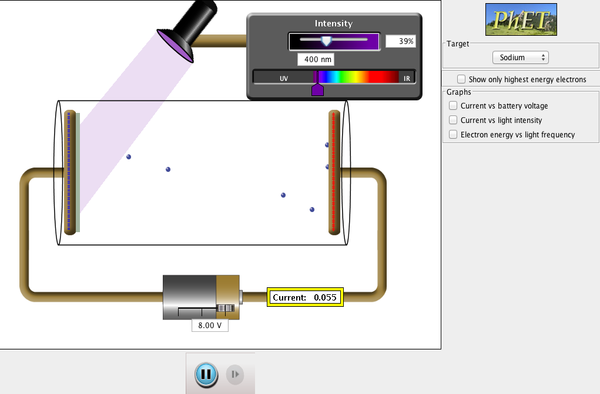
Here are the activities I've written for sims involving the atom and the nucleus.
Using PhET's Radioactive Dating Game sim, correctly estimate the age of the various virtual objects (skulls, rocks, etc.) using the principles of radiometric dating
The PhET program at the University of Colorado/Boulder has been making quality simulations since the 1990s. I don't recall the exact details of when I started crafting activities around them. But I know I chose to work PhET-based activities into my Conceptual Science lab manuals because I could count on them being universally accessible, free of charge.
When PhET ported its legacy Flash and Java sims into HTML5, some characteristics of the sims changed. Some of the changes broke some of the activities I had written for the original simulations.
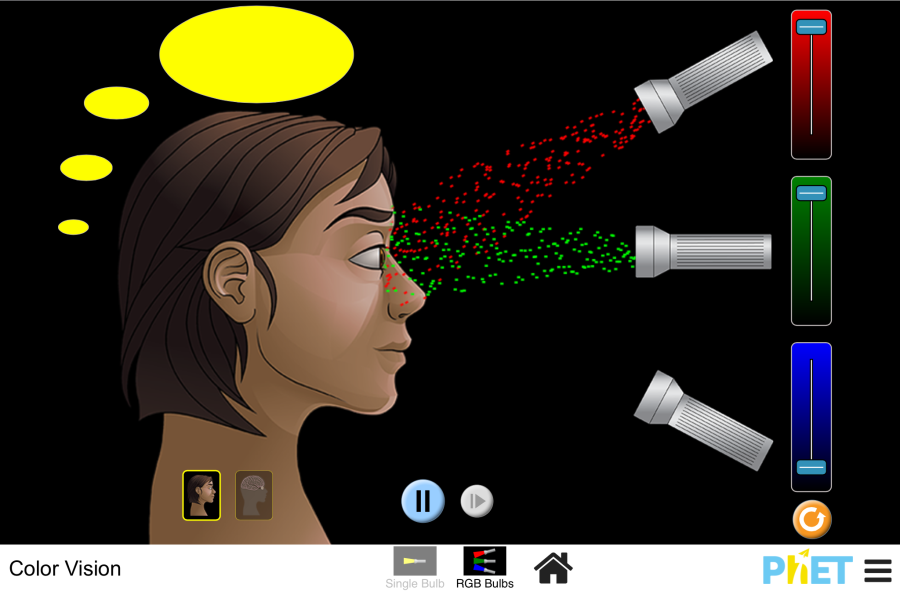
Here are the activities I've written for sims involving light and optics.
The PhET program at the University of Colorado/Boulder has been making quality simulations since the 1990s. I don't recall the exact details of when I started crafting activities around them. But I know I chose to work PhET-based activities into my Conceptual Science lab manuals because I could count on them being universally accessible, free of charge.
When PhET ported its legacy Flash and Java sims into HTML5, some characteristics of the sims changed. Some of the changes broke some of the activities I had written for the original simulations.
Once upon another time, Pasco Scientific produced and developed an application called DataStudio. It's primary purpose was to monitor and process data from Pasco's sensors. But it also had a sound creation and monitoring capability called Waveport. Pasco reimagined its data processing software when it developed Capstone and Spark. Data monitoring was improved. But sound capabilities were left behind. I was a big fan of Waveport and have yet to find a suitable replacement.
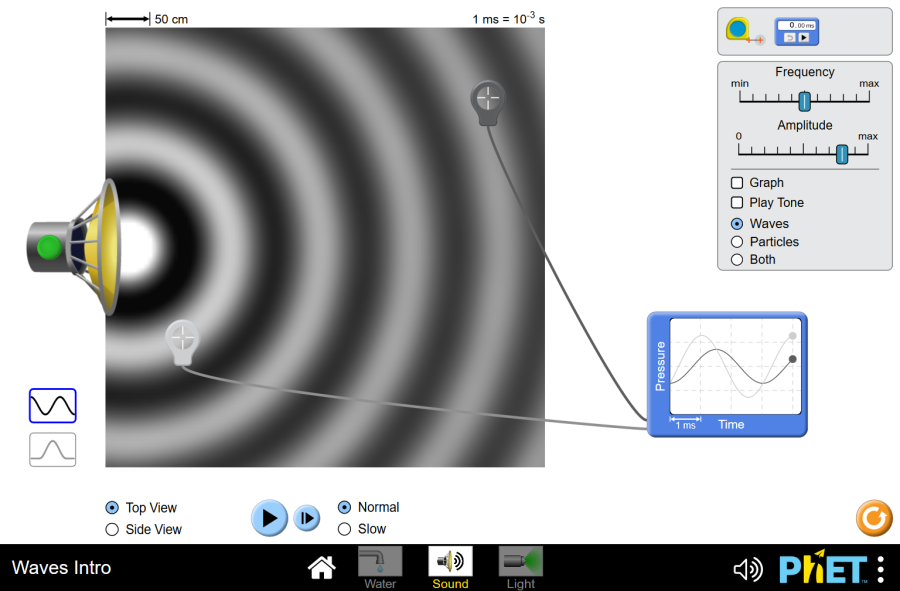
Here are the activities I've written for sims involving waves and sound.
This activity was built around Pasco's DataStudio Waveport interface. That software has been discontinued. I was able to continue using it in Mac OS X 10.14 Mojave, but 10.15 Catalina won't run it. So macOS 11 Big Sur and macOS 12 Monterey are no go, too. If you know of something that matches its functionality and still works, let me know in the comments. This activity is included in the Conceptual Physics 12th edition lab manual at Pearson.
The PhET program at the University of Colorado/Boulder has been making quality simulations since the 1990s. I don't recall the exact details of when I started crafting activities around them. But I know I chose to work PhET-based activities into my Conceptual Science lab manuals because I could count on them being universally accessible, free of charge.
When PhET ported its legacy Flash and Java sims into HTML5, some characteristics of the sims changed. Some of the changes broke some of the activities I had written for the original simulations.
Original John Travoltage was more fun than HTML5 John Travoltage, in my experience. The audio seemed to be a sample from John Travolta, himself. Over-charging John resulted in a quirky form of corona discharge. Most importantly, it was possible to sustain a maximum-length discharge indefinitely. Good times. Oh, well.
Here are the activities I've written for sims involving electricity and magnetism.
Using PhET's John Travolage sim, determine the likelihood of getting a “carpet shock” (based on controllable variables), and to avoid or produce such shocks under a series of challenging conditions. This activity is included in the Conceptual Physics 12th edition lab manual at Pearson.
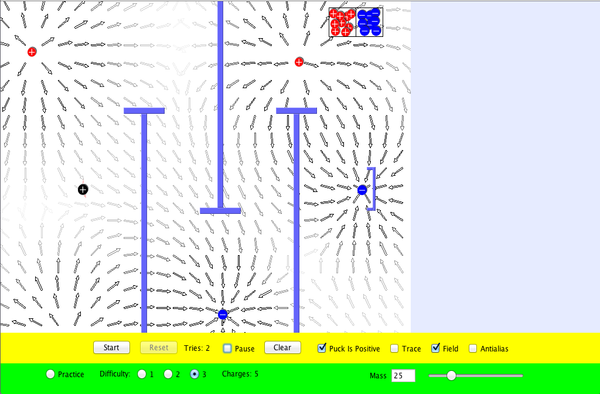
Using PhET's Electric Field Hockey sim, use a simulation to gain a sense of the vector nature of the electric field and the consequence of the inverse square law that governs electrostatic force by completing a series of game-like challenges. This activity is included in the Conceptual Physics 12th edition lab manual at Pearson.
Using PhET's Circuit Construction Kit *DC) sim, explore various arrangements for delivering energy from the battery to the bulbs, and how some arrangements compare with the others. [This was written during the pandemic to emulate an existing in-person lab activity.]
The PhET program at the University of Colorado/Boulder has been making quality simulations since the 1990s. I don't recall the exact details of when I started crafting activities around them. But I know I chose to work PhET-based activities into my Conceptual Science lab manuals because I could count on them being universally accessible, free of charge.
When PhET ported its legacy Flash and Java sims into HTML5, some characteristics of the sims changed. Some of the changes broke some of the activities I had written for the original simulations.
Here are the activities I've written for sims involving fluids and heat.
This was developed with PhET's original Density sim. The Density sim has since been updated to HTML5. I have not yet tested the activity instructions on the updated sim. In any case... In this activity, students rank items by mass, size, density, and to determine a density-based rule for floatation. This activity is included in the Conceptual Physics 12th edition lab manual at Pearson.
Pool Cubes: Buoyancy [Buoyancy] at PhET [Unavailable pending simulation update.]
This was developed with PhET's original Buoyancy sim. The Buoyancy sim is being updated to HTML5. I have not yet tested the activity instructions on the updated sim. In any case... Investigate the nature of the buoyant force and to see the role it plays in determining whether or not an object floats. The ability to use a variety of objects in the liquid and to vary the density of the liquid makes a number of scenarios possible. This activity is included in the Conceptual Physics 12th edition lab manual at Pearson.
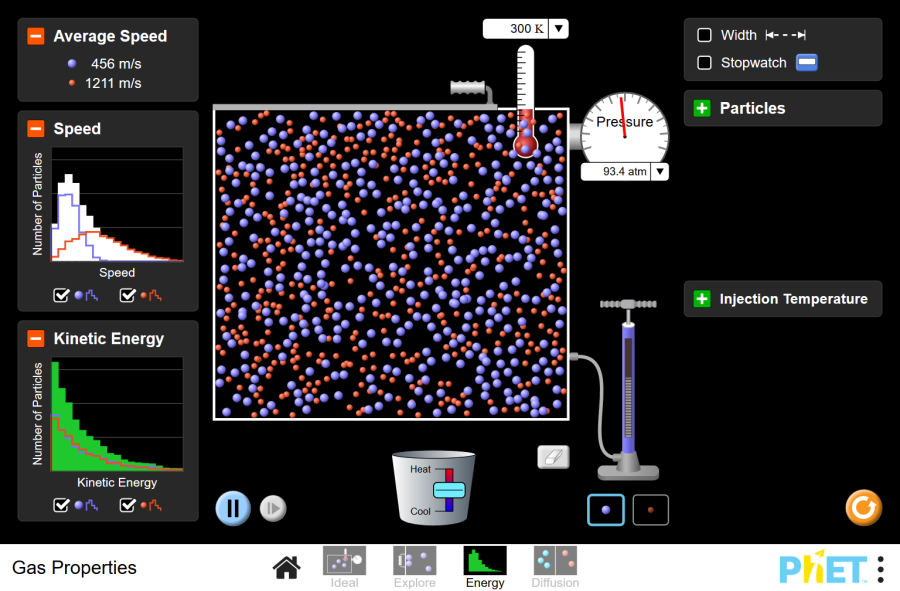
This was developed with PhET's original Gas Properties simulation. When the sim was updated to HTML5, the since model changed. Adiabatic heating still happens under compression, but adiabatic cooling no longer occurs under expansion. Using PhET's Gas Properties sim, control and observe the behavior of gas particles (atoms or molecules) as modeled in a simulation to investigate properties of gas such as temperature and pressure.
The PhET program at the University of Colorado/Boulder has been making quality simulations since the 1990s. I don't recall the exact details of when I started crafting activities around them. But I know I chose to work PhET-based activities into my Conceptual Science lab manuals because I could count on them being universally accessible, free of charge.
When PhET ported its legacy Flash and Java sims into HTML5, some characteristics of the sims changed. Some of the changes broke some of the activities I had written for the original simulations.
In the case of Projectile Motion, my activity requirements forced me to use a different online simulation: Galileo and Einstein by University of Virginia's Physics Department.
In the case of My Solar System PhET is in the process of upgrading the sim to HTML5 as of this writing. So this alternative was found. (Hat tip: Dan Burns.)
Here are the activities I've written for sims involving motion and forces.
Using PhET's Moving Man sim (CheerpJ Java as of this writing), investigate motion graphs by manipulating a simulated on-screen “moving man.” The simulation produces graphs representing the motion of the man. This activity is included in the Conceptual Physics 12th edition lab manual at Pearson.
Dodge Nitro Jump [Free Fall Algebraic Kinematics] at Teachers Pay Teachers
This currently uses Galileo and Einstein's Projectile Motion Applet. As of this writing, PhET's HTML5 Projectile Motion simulation limits initial speeds to 30 m/s, which is too slow for this activity.
Tavurvur Erupts [Projectile Motion] at Teachers Pay Teachers
This currently uses Galileo and Einstein's Projectile Motion Applet. As of this writing, PhET's HTML5 Projectile Motion simulation limits initial speeds to 30 m/s, which is too slow for this activity.
Over the years, I concocted plenty of duds. But also many keepers. The keepers I polished each year based on classroom experience with real students.
Porting my own classroom labs over to lab manual labs was non-trivial. I authored my work in art/design software: Silicon Beach Software SuperPaint, then Deneba Canvas, then Apple Keynote. I prioritized art over text. But Pearson needed "camera ready copy" in Microsoft Word. Word had quirks to be wrestled with, and it was not a platform designed for creating exacting art. Personal touches and inside joke had to be stripped. But the core purpose and process was to be retained.
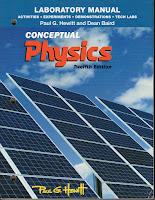
The lab manual for the 12th edition of Conceptual Physicswas the last one Pearson asked for. It was the best one I wrote for the Conceptual Science team in terms of activity quality and textbook alignment. The 13th edition of Conceptual Physics was subsequently published without a corresponding lab manual.
Following the success of 2007's Conceptual Integrated Science for the college textbook market, Conceptual Integrated Science Explorations was produced for the school (7-12) market. It was published in 2010.
This title mirrored Conceptual Physical Science Explorations for the school market. The content once again added biology to physics, chemistry, and earth science.
Most of my work was to align the lab manual to the textbook in terms of the sequencing.
In 2017, Pearson sold its K-12 division but maintains its Higher Ed division.
As laser pointers became available to physics teachers, we took to puffing clouds of chalk dust, fog-in-a-can, or other particulate scattering agents into our classrooms to demonstrate the the magic of light amplification by the stimulated emission of radiation.
One year, I initiated a school-wide fire alarm during such a demonstration. The previous summer, the custodians had been tasked with cranking up smoke detector sensitivity to 11, unbeknownst to me.
Another thing we began doing was to shine our laser beams into water-filled fish tanks. The beams were again more visible when a scattering agent was deployed. Some used milk, some likes Pine-Sol. I used contact lens cleaning solution before settling on Mop-N-Glo.
But fish tanks were heavy, and the gallons and gallons of water made them downright unwieldy. It was a teacher-only demonstration activity.
As nice as it is for students to remember Physics as the class where the teacher did cool things, I wanted them to remember it was the class where they did cool things.
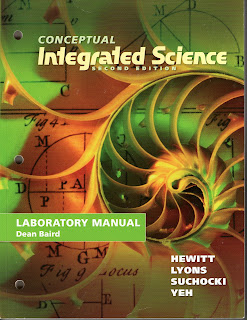
Suzanne Lyons had a vision of expanding Conceptual Physical Science to include biology: Conceptual Integrated Science.
On Hewitt's Conceptual Science team, I was the lab manual author, so I was asked to handle the lab manual for this title.
But I was a mere high school physics teacher with a full-time job teaching physics. I had more than enough physics lab ideas, but I was already using John Suchocki's chemistry labs and Leslie Abrams' earth science labs in the Conceptual Physical Science titles. Biology labs? Not a chance. I was in over my head.
Suzanne contributed great earth science labs, and we outsourced biology labs from Anne Coleman. My contribution was formatting them and giving them the kind of whimsical titles so they matched the style of the manual.
I probably should have been credited as the lab manual wrangler. But in the wild world of publishing, that made me author of record.
The second edition lab manual ran into production difficulties and was a bit delayed, but it eventually saw the light of day. Of all the lab manuals I produced, this is the one best aligned to its corresponding textbook. I'm proud of that. It also seems to have lost its place in the Pearson catalogue. The 3rd edition of the Conceptual Integrated Science textbook has since been published without a lab manual.