Monday, January 1, 2007

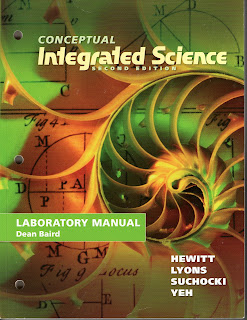
Conceptual Integrated Science


Suzanne Lyons had a vision of expanding Conceptual Physical Science to include biology: Conceptual Integrated Science.

On Hewitt's Conceptual Science team, I was the lab manual author, so I was asked to handle the lab manual for this title.

But I was a mere high school physics teacher with a full-time job teaching physics. I had more than enough physics lab ideas, but I was already using John Suchocki's chemistry labs and Leslie Abrams' earth science labs in the Conceptual Physical Science titles. Biology labs? Not a chance. I was in over my head.

Suzanne contributed great earth science labs, and we outsourced biology labs from Anne Coleman. My contribution was formatting them and giving them the kind of whimsical titles so they matched the style of the manual.

I probably should have been credited as the lab manual wrangler. But in the wild world of publishing, that made me author of record.

The second edition lab manual ran into production difficulties and was a bit delayed, but it eventually saw the light of day. Of all the lab manuals I produced, this is the one best aligned to its corresponding textbook. I'm proud of that. It also seems to have lost its place in the Pearson catalogue. The 3rd edition of the Conceptual Integrated Science textbook has since been published without a lab manual.

Saturday, January 1, 2005

Paul Hewitt's Next Time Questions

Next-Time Questions are favorite insightful questions I have asked my students over my teaching career. I have embellished them with cartoons to catch interest. Their intention is to elicit student thinking. My use of them was posting several in a glass case outside my lecture hall—without answers. The wait-time for answers was one week. I could have called them Next-Week Questions, which would have been more appropriate.

Most of these have been published over the years as Figuring Physics in The Physics Teacher magazine. They have also been in ancillaries to my Conceptual Physics textbooks, and physical science textbooks as well. My hope is that teachers will pose the questions, and withhold answers to “next time,” which could be as early as the next class meeting. Their educational value is the long wait time!

Thursday, January 1, 2004

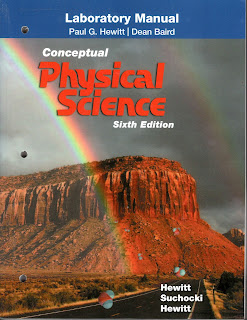
Conceptual Physical Science

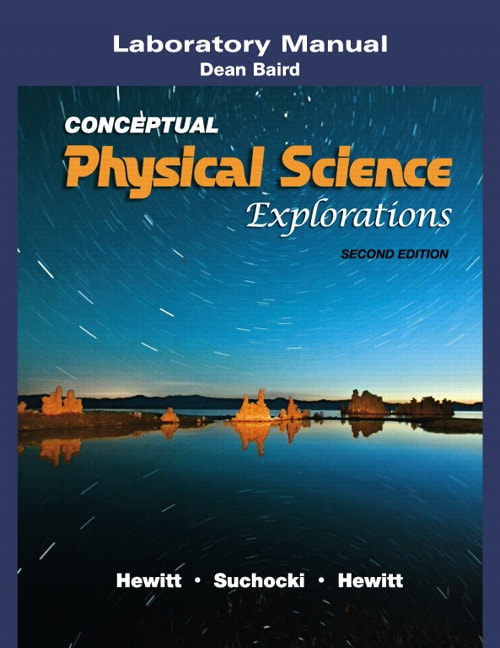
As soon as Conceptual Physical Science Explorations was published, it was time to get to work on the 3rd edition of the college Conceptual Physical Science.

I could now use the CPSE lab manual as a foundation and bring more of my own labs into the project. The insanity of the tight CPSE timeline was no more. I was getting better at MS Word: learning how to work around its quirks and learning how to create diagrams with its art tools. The 3rd edition (my 1st edition on the team) was published in 2004.

The Conceptual Physical Science textbook did very well in the marketplace. Fourth and 5th editions followed in 2008 and 2012.

Hewitt became a regular at NSTA conferences in this era, and I joined him every chance I got. Pearson would typically schedule a session for him to promote the school (Explorations) Conceptual Science textbooks. Hewitt had me describe the nature of the lab manual within his session. I brought photos, and I brought demonstrations. The conferences were always a good chance to hang out with the Hewitts and catch up with friends at Arbor Scientific, Pasco, and PhET. I actually worked the PhET booth for several hours when NSTA came to San Francisco.

Wednesday, January 1, 2003

Conceptual Physical Science Explorations

How I Met Paul Hewitt
I attended my first Northern California and Nevada Section of the American Association of Physics Teachers meeting in the autumn of 1986 at American River College in Sacramento. Among the instructors doing Show & Tell that morning was Conceptual Physics author, Paul Hewitt.

There aren't many celebrities in the world of physics teachers, but Paul Hewitt was one. His Conceptual Physics textbook had been growing in popularity at colleges since 1971, and the then-new Conceptual Physics: A High School Program was in the process of shaking up the high school physics textbook market.

But there was Hewitt, just another person in the queue to present a demonstration to the NorCal family of physics instructors. I did my best to play it cool.

In 1989, the AAPT's Summer Meeting was in San Luis Obispo. This was my first national meeting. One day at lunch, I found myself across the table from Hewitt and we chatted it up, but I gave him no reason to remember me.

Thursday, February 1, 1996

The Blowgun as a Teaching Tool

One of the first things I acquired through the bureaucratic school district purchase requisition process was Pasco Scientific's Lenz's Law Demonstrator. As a newly-minted classroom teacher, I found the prices in supplier catalogs to by eye-popping. (I have a better understanding of the economics and value propositions of those prices now.)

I used the satin-finished aluminum tube and magnets for its intended purpose right away. 

I then added some intrigue/obfuscation by hiding a stack of potent neodymium magnets inside a hollowed out red whiteboard marker. I told students that the tube could detect the marker's color and try to stop the fall of the red marker. To "prove" my point, I would drop an unmodified green marker through the tube showing that the tube offered no resistance. Some students would demand up-close inspection. They found the red marker was heavier: the heavier marker fell more slowly!

I typically ran this demo on the first day of school as part of my "Physics Begins with an M" first day of school lesson. The explanation had to wait until second semester, when we studied magnetism.

Since this demo was so costly, I felt I had to add value. I found I could balance it vertically on my classroom floor to demonstrate unstable equilibrium. And when it toppled over, the sound it made could pierce your soul. Students would emit involuntary screams. 

Holding the tube with thumb and forefinger at various places while gently bouncing it on the tile floor produced different notes as different resonance modes were activated.