Monday, August 21, 2023
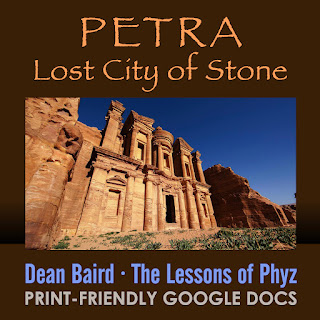
Petra: Lost City of Stone
Thursday, August 17, 2023
Hagia Sophia: Istanbul's Ancient Mystery

Tuesday, August 15, 2023
Can Psychedelics Cure?
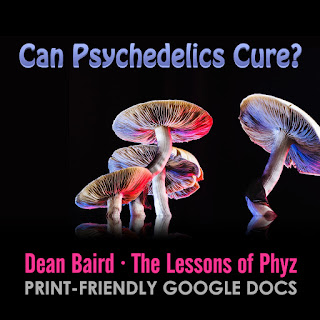
These are not happy topics, and this episode of PBS's NOVA gets a content warning. It has a few rough moments, but it's working with treatments for difficult diagnoses.
As an educator, I was part of a culture that cast anything that could be considered a recreational drug as public enemy number one. Just as Richard Nixon labeled them when he was president. The closest I've come to illicit drug use has been breathing the air at rock concerts, where the air can grow thick with marijuana smoke.
In any case, Can Psychedelics Cure? presents anecdotes and data suggesting that psychedelics have curative properties when administered appropriately. The FDA will have the final say. Here's where the FDA stood as of June, 2023.
Saturday, August 12, 2023
Hidden Volcano Abyss
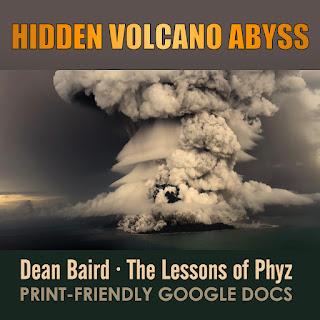
We get accounts, video, and photographs from residents of Tonga who survived the tsunami and rain of debris and ash. It's a testament to their preparedness that only three people died. Still though, the human story is not without emotion.
We also get the forensic geology of the science team that determined why the eruption was 70 time more powerful than anything the volcano had previously produced, and how it produced a rare volcanic tsunami. Detective work and deduction.
And research into the likelihood of another eruption in the near future. Right now on NOVA.
Monday, August 7, 2023
The Story of Maths
Adults are shown enjoying adult beverages. The use of mathematics to schedule conjugal visits between a Chinese emperor and the 121 women in his hareem is illustrated. A prolific author of math texts who never actually existed. A mathematician who upended the field before losing a duel before his 21st birthday. The story of a nightclub dancer protecting a prestigious mathematician from Nazi thugs is told. And more.
Amid these spices is the history of math from before the invention of the number zero to recent attempts to prove the Riemann hypothesis. Host Marcus du Sautoy travels the world to visit key historical locations and talk to notable contemporary mathematical giants.
This is the human story of math.
We do math. We love math. And math coursework is devoted to the ideas and mechanics of math. Rightfully so. Here are four hours that humanize math. It might be a worthy diversion to contextualize high school or college mathematics.
Tuesday, July 25, 2023
Digital Remastering: The Summer Work of 2023
The Lessons of Phyz at TPT (Teachers Pay Teachers) began in 2018 with the publication of question sets for The Mechanical Universe (High School Adaptation) episodes. At the time, those episodes were not available for purchase, nor did they stream. [Now, all episodes of The Mechanical Universe stream freely.]

Other series and a variety of single-episode documentaries were added in 2019. When the pandemic hit in 2020, it became clear that the Google Docs format was the new PDF, so I began the work of transforming all my extant PDF resources into Google Docs. When remote teaching morphed into hybrid learning in 2021, I found I needed to post resources as "print-friendly Google Docs", files that could be assigned and collected in Google Classroom (or other LMSs) and could also be printed for use in the classroom for in-person instruction.
Hundreds of resources have since been added. The Lessons of Phyz offers 640 products as I write this post. But as the months and years have rolled by, I have discovered a few things about my resources.
I've solidified some formatting and style aesthetics that weren't always consistent in the early works. And I've notice a phenomenon that I can only refer to as "digital drift": a microscopic change in Google's fonts or kerning which—on rare occasions—altered the formatting in some documents, especially when printing them.
So I've spent this summer "digitally remastering" the old documents so that they would behave better in general, and when particularly printed. It's important to me that these documents perform as I intended them to when I created them.
As I was finishing that work, news arrived that Paul Hewitt's Conceptual Physics Alive! video series had become available to stream or download for free. So I remastered all my CPA question sets to include clickable links to the corresponding video. Embedded video links were already incorporated in The Mechanical Universe, Kinetic Karnival, and other series and stand-alone episodes in which a video streamed freely.
Any typos found in remastering were fixed. I suppose it was like weeding a garden.
In any case, the store's products have been polished and the shelves are handsomely stocked as we head into the 2023-24 school year.

Oh, and TPT has a new logo, too. It combines the apple and document sharing elements of the legacy logo and the color scheme of the short-lived, newer logo. I like it.
Sunday, July 2, 2023
The Lessons of Phyz Advantages
VIDEO QUESTION SET EDITION · [crossword puzzle edition here]
An abbreviated summary of "Lessons of Phyz Advantages" is provided in each video question set's product description. This post dives a bit deeper.
Why question sets at all?
I was never comfortable showing a video in class without an accompanying question set. Casting students as passive observers didn't seem like a path for learning. And it's asking a lot of students: to actively engage with an inherently passive exercise.
Depth of the questions
My first significant experience as a teacher using video lessons was via The Mechanical Universe: High School Adaptation. I was able to get my school to buy me the set, and it came with a binder of resources. Among the resources was a set of questions for students to answer while watching the video.
But the prompts called for extended, written answers. Not quick, "bang-bang" responses. More reflective, analytical responses. It didn't seem like students could answer these while the video played. Rather, the video would have to be paused while students drafted and composed responses.
I didn't want to spend that much time in the video.
Further experience with such things led me to the conclusion that the producers of video content hoped their content would occupy more of your calendar than you intended.
That did not suit my needs.
So I developed shorter, tighter question sets, with questions that could be answered while the video played without pause.
The video is not my primary curriculum resource; it's a supplement. In my class, the video will play through once, and that's it. Students complete the question set while the video plays. If you're hoping for a deeper analysis and reflective responses, my video question sets are not the way to go.
Page design: print-friendly Google Docs
This topic is so important, I wrote a separate post about it: One document to rule them all. The TL;DR version is this: My question sets are Google Docs files that can be assigned to students in Google Classroom, for example, if remote teaching/distance learning is in effect. They can also be printed and used in an in-person setting. Maximum flexibility is the objective.
Because the print versions might be used in a darkened room, I chose to use a heavy sans=serif text font for increased legibility.
Question variety
Most video question sets that have been put into the world are "word-drop" questions—one-word fill in the blank. I use them, but not exclusively.
Word-drops don't really work for exotic words that are unfamiliar to students, or whose spelling is challenging. For those, I prefer a multiple-choice format. Students might not be able to spell an exotic word, but they can pick it out of a line-up when they hear it. And having done so, they can see how that exotic word is spelled.
Multiple choice question construction takes additional time and energy: now you need distractors to sit appealingly with the key.
Ages ago, I served on the physics development committee for California's short-lived Golden State Exam. Because I complained to the California Department of Education about the statewide physics exams it was developing, the State Board of Education appointed me to its Assessment Review Panel. We vetted questions developed by Educational Testing Service for use on California's Content Standards Tests. All this work made me acutely aware of the importance of quality distractors.
I also like pick-from-a-list questions. And when the material calls for it, matching is good. On rare occasions, a tour/false works well.
The point is to mix it up where possible. I don't have research to show that that makes for a more engaging, less tedious question set, but I believe it. So that's what I do.
And no student, even those who are well-read and intellectually sharp, should have much success completing the question set without watching the movie/episode.
That seems like a lot of questions!
Many question sets have nearly one question per minute of film. At first blush (and when comparing to competing products), that might see like a lot of questions. Maybe too many questions. It is not. The questions are low-level, intended to maintain student attention and focus on the content. They are not deep reflections or rich analysis. So the frequency is right for the task at hand. Teachers who initially found the load to be intimidating were surprised by how well it worked with students.
Raised ceilings: space for writing
Sometimes a word-drop question has enough verbiage that the dropped word occurs in the second line of text. In those cases, I add some vertical space so that students have room to write (when the document is in print form); no need to scrunch the handwriting. Not all author-creators think of this.
No unnecessary art
Most of my question sets are pure text. The visuals and graphics are the domain of the video. If anything, the question sets represent a translation of the visual and auditory to text. I don't see any value in clip-art or screen grabs. On some (rare) occasions, there is value in interpretation of a graphic element or graph.
Non-breaking space
This one is weed-deep. When a question calls for selecting items from a list, often the list of items can be fit to a single line of text. Sometimes items in the list consist of more than one word. When using the Google Docs file, it's convenient to be able to double-click an item on the list to select it. But if the item has more than one word, double-clicking only selects one word. I use a non-breaking space between the words so that both words are selected on the double-click. Like I said, this one is deep in the weeds.
Play to the buzzer
When you ask students to maintain attention throughout the video by using a question set, many will lose focus after the answer to the final question is revealed. So it's best to have that occur as close to the end of the video. If it's the last word of the video's narration, all the better.
Monday, June 26, 2023
The Brain
Neuroscientist David Eagleman explores the human brain in an epic series that reveals the ultimate story of us, why we feel and think the things we do. This ambitious project blends science with innovative visual effects and compelling personal stories, and addresses some big questions. By understanding the human brain, we can come close to understanding humanity.
Monday, June 19, 2023
Our Planet II
This follow-up miniseries centers on migrations and seasons. Well, months more than seasons as it trots the globe's northern and southern hemispheres throughout one calendar year. It's perhaps a bit gentler regarding the message of anthropogenic climate change, because that science is very settled. Our Planet II was designed with bingers in mind. Each of the first three episodes ends in a cliffhanger.
Saturday, June 10, 2023
Colosseum: Roman Death Trap
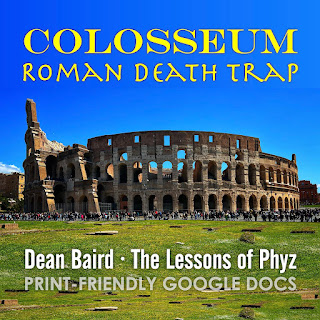
This episode of NOVA popped up as this week's summer rerun for NOVA. I visited the Colosseum in April and saw a lift made of lumber in the bowels (hypogeum) of the structure. This program tells its story, and much, much more. As the title implies, it was not a place of joy, mirth, or happiness for those who participated in the spectacles.
But there was state-of-the-art engineering going on in there. So ... I don't know who needs to use this, but there is cromulent STEM content in this episode: mechanical and hydraulic engineering as well as emission spectroscopy and bone-strengthening nutritional supplements for gladiators. Gladiators were trained in fight schools and were provided with health care. Not all gladiator fights were allowed to end in a death (given the investments in these fighters). But releasing wild apex predators into the arena via lifts and trap doors kept audiences coming back for more.
Crypto Decoded

NOVA traces the origins of crypto and what some hoped it might be able to do. From the blockchain to Ethereum, this episode does what it can to decode crypto.
From Bitcoin to NFTs, crypto is making headlines. But what exactly is it, and how does it work? Experts go beyond the hype and skepticism to unravel the social and technological underpinnings of crypto – exploring how it came to be and why this new technology may change more than just money.
Sunday, June 4, 2023
Honda Cog Ad
I always loved this two-minute ad from Honda UK. It merited an exhaustive Wikipedia entry. I showed it during our Energy units, since there were so many energy transfers and and transformations. Creating a student assignment around it was challenging, though. And doing so sat on the back-burner for some time.
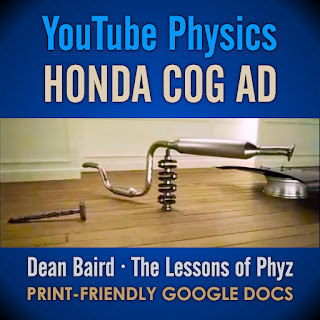 Eventually I settled on a "phenomena-match" where I created a list of physics phenomena and broke the video into 33 distinct events, with titles!
Students are asked to read the list of phenomena and then watch the video. Then they're asked to watch the video again and label each event with at least one phenomenon shown. (Some events show multiple phenomena, and students are encouraged to label as many as they see.)
But there are some restrictions. All 33 events need to tagged with at least one phenomenon, and each phenomenon must be assigned to at least one event by the end of the video. And no single phenomenon can be assigned to more than five events.
Fun, engaging, and with just a pinch of tension (as you come up on your fifth citation of "collision").
Saturday, June 3, 2023
Spin the Cradle

Center that cradle on a low-friction turntable, and you've got the makings of a nice demonstration for AP Physics 1. There's a classic uniform circular motion free-body diagram to be solved. And the solution speaks to the angle a ball will swing to when things are set into motion.
A curious counter-intuitive interpretation of the mathematics is explored. It's nerdy stuff, appropriate for the more deeply-set plow we use in the advanced level high school course.
And how cool is that cover photo, with the balls of the cradle seeming to repel one another?
Thursday, June 1, 2023
Secrets in Our DNA

My immediate take was that the more you knew about DNA, the less likely you were to buy into these tests.
I haven't purchased a test, myself. But I might get one someday. There seems to be some entertainment value and some medical value. But it's important not to set expectations very high.
That said, there is a story here. A story with several compelling threads. And this episode of NOVA gets at this story.
Thursday, May 25, 2023
Your Brain: Perception Deception + Who's In Control?
It seems there was a moment a few years ago when our collective senses of reality were universally called into question. I am speaking, of course, about The Dress. Was it blue and black or white and gold? [Disclosure: I was on Team White and Gold in the moment.] And then ... was it Yanny or Laurel? [I only hear Yanny.]
And one that I seem to have repressed: "Brainstorm" or "Green Needle"? That one added a new dimension of terror as your own brain could be flipped from Brainstorm to Green Needle by mere suggestion. The audio didn't change; your brain's interpretation changed. [Update: you can also roll with "Brain Needle" or "Green Storm" if you ... put your mind to it.]
Our faith in the fidelity of the realities our minds create around us turns out to be somewhat misplaced. This two-part series investigates that and more.
Nearly a hundred of the Exploratorium's Science Snacks involve perception. [Snacks can be sorted by subject; one of those subjects is "perception".]

Is what you see real? Join neuroscientist Heather Berlin on a quest to understand how your brain shapes your reality, and why you can’t always trust what you perceive. In the first hour of this two-part series, learn what the latest research shows about how your brain processes and shapes the world around you, and discover the surprising tricks and shortcuts your brain takes to help you survive.

Are you in control, or is your brain controlling you? Dive into the latest research on the subconscious with neuroscientist Heather Berlin. Sleepwalking, anesthesia, game theory, and more reveal surprising insights in this eye-opening journey to discover what’s really driving the decisions you make.
Bonus NOVA content: What Illusions Tell Us About Our Brains
If you have ever encountered an utterly bewildering illusion, you know the powerful effect such images have on the mind. If we can't trust what we see, then what is reality? In this virtual field trip, Professors. Susana Martinez-Conde and Stephen Macknik will present a smorgasbord of mystifying illusions selected from their Best Illusion of the Year Contest. Martinez-Conde and Macknik, who study the intersection of neuroscience, illusions, and stage magic, will explain just why we think we see the things we see.
Friday, May 12, 2023
Conceptual Physics Alive! is now streaming freely
Great news, physics types!
For your professional development, your classroom, or for your own delight, Paul Hewitt's classic CPAlive! lectures are gifted to you here for streaming or download. Enjoy! To learn more about Paul's latest (2023) "Conceptual Academy Physics" full high school program, visit ThePocketLab.com. Good Energy!
Conceptual Physics Alive! [A handy index page with links to episodes and question sets]
Saturday, May 6, 2023
Physics for the 21st Century

This might be something nice for after the AP exams in your AP Physics course. High school physics content was developed in the 17th-20th centuries. This series gets you past 1927.
Thursday, May 4, 2023
Chasing Carbon Zero

Climate journalist, Miles O'Brien, takes us on a journey whose destination is "Net Zero" carbon. That's where we're supposed to be by 2050 to avoid a range of climate-related catastrophes. Those catastrophes are starting to show themselves here in 2023, so the need is clear.
As with Weathering the Future, this documentary doesn't waste time making the case that climate change is happening. That's settled science. It's documented elsewhere in the world of documentaries.
This program is devoted to the nuts and bolts of how we get from here to carbon zero. It's a difficult, but not impossible task. For some key carbon contributors, innovation is no longer needed. We have the tools we need. But we need to implement them.
Monday, April 24, 2023
Weathering the Future

Now we are documenting human responses to climate change. NOVA's Weathering the Future stands as a solid example. It doesn't spend time presenting the science establishing climate change. It understands that climate change is a reality that is having concrete consequences in communities right now. It spends its time detailing community responses to climate change impact.
Thursday, April 6, 2023
Big Links Pages
Really just an excuse for me to post a favorite shot from Brooks Falls, Katmai, Alaska a few years ago. Arctic Lynx.

In any case, I always found some utility in big pages of links for video series. Links to videos (where possible) and question sets. So I made some for video series in various content areas. Here's what I've got.
A Personal Voyage [Carl Sagan 1980: 13 episodes]
A Spacetime Odyssey [Neil deGrasse Tyson 2014: 13 episodes]
Possible Worlds [Neil deGrasse Tyson 2020: 13 episodes]
Chemistry: A Volatile History [Jim Al-Khalili: 3 episodes]
Hunting the Elements ... Beyond the Elements [David Pogue]
Chemistry: Challenges and Solutions [13 episodes]
The World of Chemistry [Roald Hoffmann: 26 episodes]
How Earth Made Us | How the Earth Changed History [Iain Stewart: 5 episodes]
Earth Revealed: Introductory Geology [26 episodes]
The Habitable Planet: A Systems Approach to Environmental Science [13 episodes]
I'll keep these lynx links over in the bar on the right.

Subscribe to:
Posts (Atom)